
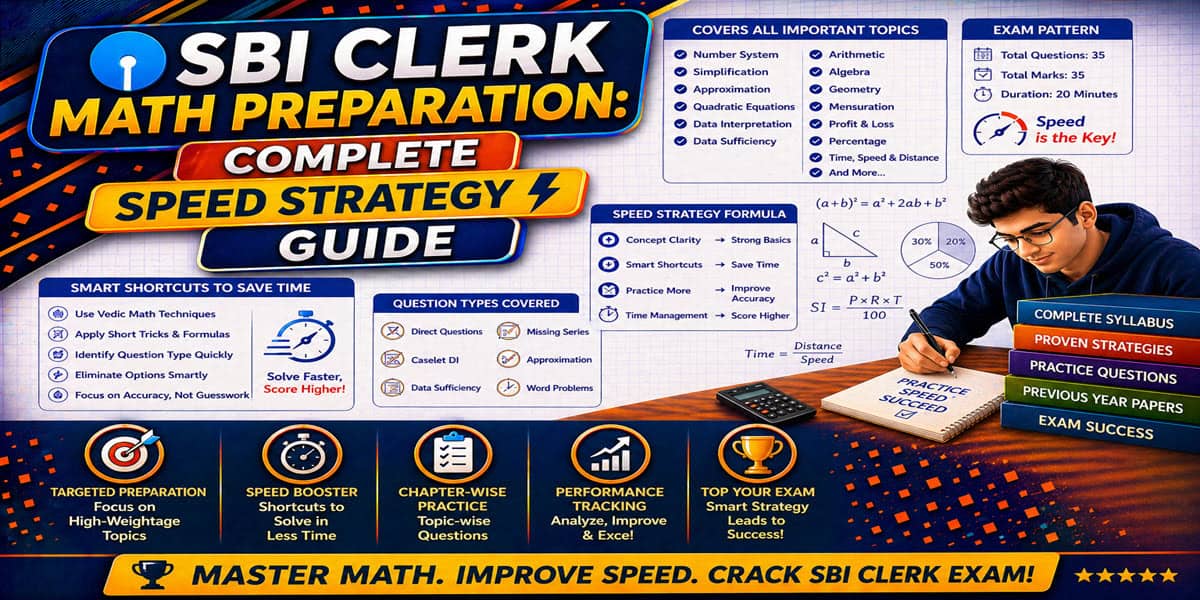
SBI Clerk — officially known as SBI Junior Associates — is one of the most popular entry-level banking examinations in India. Conducted by the State Bank of India, it attracts millions of applicants every year for clerical cadre posts across SBI branches nationwide. The quantitative aptitude section is a key differentiator — with high competition, even 1–2 extra marks can determine whether a candidate qualifies for Mains.
The math in SBI Clerk is noticeably easier than SBI PO — but the competition is equally intense, which means accuracy and speed matter just as much. Prelims tests basic arithmetic and simplification at moderate difficulty. Mains goes deeper — introducing data interpretation sets, complex arithmetic, and higher-difficulty word problems that require both conceptual clarity and calculation speed.
This guide gives you the complete SBI Clerk math preparation strategy — exam pattern, topic-wise weightage, shortcuts, worked examples for every question type, attempt strategy, and a 45-day practice plan. For SBI PO-level strategy, refer to our SBI PO Math guide. For IBPS Clerk comparison, refer to our IBPS Clerk Math guide.
Part 1: SBI Clerk Exam Pattern — Quantitative Aptitude
Prelims Pattern
| Section | Questions | Marks | Time |
|---|---|---|---|
| English Language | 30 | 30 | 20 min |
| Numerical Ability | 35 | 35 | 20 min |
| Reasoning Ability | 35 | 35 | 20 min |
| Total | 100 | 100 | 60 min |
Key insight: 35 questions in 20 minutes = 34 seconds per question. Same pace as SBI PO Prelims — but easier questions.
Mains Pattern
| Section | Questions | Marks | Time |
|---|---|---|---|
| General English | 40 | 40 | 35 min |
| Quantitative Aptitude | 50 | 50 | 45 min |
| Reasoning Ability and Computer Aptitude | 50 | 60 | 45 min |
| General/Financial Awareness | 50 | 50 | 35 min |
| Total | 190 | 200 | 2 hrs 40 min |
Key insight: 50 QA questions in 45 minutes = 54 seconds per question. More time than Prelims — but harder questions.
Negative marking: 0.25 marks per wrong answer in both Prelims and Mains.
Part 2: Topic-Wise Weightage
Prelims — 35 Questions Distribution
| Topic | Questions | Priority |
|---|---|---|
| Simplification / Approximation | 10–15 | 🔴 Very High |
| Number Series | 5 | 🔴 Very High |
| Arithmetic Word Problems | 15–20 | 🔴 Very High |
Arithmetic subcategories in Prelims:
- Percentage and profit-loss (3–4 questions)
- SI and CI (1–2 questions)
- Time-Work (1–2 questions)
- Speed-Distance-Time (1–2 questions)
- Ratio-Proportion (1–2 questions)
- Average (1–2 questions)
- Age Problems (1 question)
Mains — 50 Questions Distribution
| Topic | Questions | Priority |
|---|---|---|
| Data Interpretation | 15–20 | 🔴 Very High |
| Arithmetic Word Problems | 15–20 | 🔴 Very High |
| Simplification | 5–10 | 🔴 High |
| Number Series | 5 | 🔴 High |
| Quadratic Equations | 5 | 🟡 Medium |
| Miscellaneous | 3–5 | 🟡 Medium |
Part 3: Simplification — The Fastest Scoring Block
10–15 simplification questions in Prelims — target all correct in under 10 minutes.
BODMAS — Strict Application
Worked Example 1:
Simplify: (144 ÷ 12 + 8) × 5 − 3²
= (12 + 8) × 5 − 9
= 20 × 5 − 9
= 100 − 9 = 91
Worked Example 2:
Simplify: 3/5 of 850 + 2/7 of 595 − 45
= 510 + 170 − 45 = 635
Approximation — SBI Clerk Style
Worked Example 3:
Approximate: √(6240) + (24.97)² − 399.8
√6240 ≈ √6241 = 79 (since 79² = 6241)
(24.97)² ≈ 25² = 625
≈ 79 + 625 − 400 = 304
Worked Example 4:
Approximate: 34.98% of 1800 − 19.9% of 900
≈ 35% of 1800 − 20% of 900
= 630 − 180 = 450
Must-Memorize Values for Simplification Speed
Squares 1–25:
1,4,9,16,25,36,49,64,81,100,121,144,169,196,225,256,289,324,361,400,441,484,529,576,625
Cubes 1–15:
1,8,27,64,125,216,343,512,729,1000,1331,1728,2197,2744,3375
Square roots of perfect squares up to 400:
√144=12, √169=13, √196=14, √225=15, √256=16, √289=17, √324=18, √361=19, √400=20
See More Here: Learn Table/Square/Cube
Part 4: Number Series — 5 Guaranteed Marks
SBI Clerk number series follows standard banking exam patterns — slightly easier than SBI PO.
Worked Example 5:
Find missing: 6, 11, 21, 41, 81, ___
Pattern: ×2−1 each time
6×2−1=11, 11×2−1=21, 21×2−1=41, 41×2−1=81
81×2−1 = 161
Worked Example 6:
Find missing: 144, 121, 100, 81, 64, ___
Pattern: 12², 11², 10², 9², 8² → next = 7² = 49
Worked Example 7:
Find missing: 5, 6, 14, 45, 184, ___
Pattern: ×1+1, ×2+2, ×3+3, ×4+4, ×5+5
184×5+5 = 920+5 = 925
Worked Example 8:
Find wrong term: 3, 5, 13, 43, 176, 891
Pattern: ×1+2, ×2+3, ×3+4, ×4+5, ×5+6
3, 5, 13, 43, 177, 891
176 is wrong — should be 177
Part 5: Arithmetic Word Problems — Complete Coverage
Percentage
Worked Example 9:
A's income is 25% more than B's. By what % is B's income less than A's?
Let B = 100, A = 125
B is less than A by: 25/125 × 100 = 20%
Shortcut: If A is x% more than B → B is x/(100+x) × 100% less than A
= 25/125 × 100 = 20% ✓
Worked Example 10:
Price of sugar increases by 20%. By what % should consumption be reduced to keep expenditure same?
Reduction = 20/(100+20) × 100 = 20/120 × 100 = 16.67%
Profit and Loss
Worked Example 11:
By selling 45 articles for Rs. 40, a trader loses 20%. To gain 20%, how many articles should be sold for Rs. 40?
SP of 45 = 40 → SP per article = 40/45 = 8/9
Loss 20% → CP per article = (8/9) ÷ 0.80 = 10/9
For 20% gain → SP per article = 10/9 × 1.20 = 12/9 = 4/3
Articles for Rs. 40 = 40 ÷ (4/3) = 40 × 3/4 = 30 articles
Simple and Compound Interest
Worked Example 12:
Difference between CI and SI for 2 years at 10% on Rs. 5,000.
Difference = P × (r/100)² = 5000 × (10/100)² = 5000 × 0.01 = Rs. 50
This shortcut works for exactly 2 years only.
Worked Example 13:
At what rate of SI does a sum double in 8 years?
SI = P → P = P×R×8/100
R = 100/8 = 12.5% per annum
Time and Work
Worked Example 14:
20 men complete a work in 15 days. After 5 days 5 men leave. How many more days to finish?
Total work = 20 × 15 = 300 units
Work done in 5 days = 20 × 5 = 100 units
Remaining = 200 units
Remaining men = 15
Days = 200/15 = 13.33 days
Speed, Distance and Time
Worked Example 15:
A train passes a standing man in 8 seconds and a 264m platform in 20 seconds. Find train length and speed.
Let train length = L
L/8 = (L+264)/20
20L = 8L + 2112
12L = 2112 → L = 176m
Speed = 176/8 = 22 m/s = 22 × 18/5 = 79.2 km/h
Ratio, Proportion and Mixture
Worked Example 16:
Two vessels contain milk and water in ratio 3:1 and 5:3. Mixed equally. Find final ratio.
Vessel 1: milk=3/4, water=1/4
Vessel 2: milk=5/8, water=3/8
Mixed equally (1 litre each):
Milk = 3/4 + 5/8 = 6/8 + 5/8 = 11/8
Water = 1/4 + 3/8 = 2/8 + 3/8 = 5/8
Ratio = 11:5 → Milk:Water = 11:5
Part 6: Data Interpretation — Mains Focus
DI contributes 15–20 questions in Mains — the highest-weightage topic.
DI Types in SBI Clerk Mains
| Type | Frequency |
|---|---|
| Table | Very High |
| Bar Graph | Very High |
| Pie Chart | High |
| Line Graph | High |
| Caselet | Medium |
DI Worked Example — Table
| Branch | Total Staff | Male | Female |
|---|---|---|---|
| A | 120 | 75 | 45 |
| B | 150 | 90 | 60 |
| C | 100 | 55 | 45 |
Q1: Female staff in Branch B as % of total staff in Branch A?
= 60/120 × 100 = 50%
Q2: Average male staff across all branches?
= (75+90+55)/3 = 220/3 = 73.33
Q3: Ratio of female staff in A to C?
= 45:45 = 1:1
Part 7: Attempt Strategy
Prelims — Recommended Order
| Round | Topic | Questions | Time |
|---|---|---|---|
| 1st | Simplification (all) | 10–15 | 8 min |
| 2nd | Number Series (all) | 5 | 3 min |
| 3rd | Easy arithmetic (percentage, average, ratio) | 8–10 | 6 min |
| 4th | Remaining arithmetic | As many as possible | 3 min |
| Total | 28–32 | 20 min |
Target: 28–30 attempts with 88%+ accuracy = 24–26 marks out of 35.
Mains — Recommended Order
| Round | Topic | Questions | Time |
|---|---|---|---|
| 1st | Simplification (all) | 5–10 | 6 min |
| 2nd | Number Series (all 5) | 5 | 4 min |
| 3rd | DI sets | 15–20 | 18 min |
| 4th | Arithmetic word problems | 10–12 | 12 min |
| 5th | Quadratic equations | 5 | 5 min |
| Total | 40–45 | 45 min |
Target: 38–42 attempts with 85%+ accuracy = 32–36 marks out of 50.
Cut-off Awareness
SBI Clerk Prelims QA cut-off: typically 10–14 marks.
Safe score for Mains qualification: 22+ marks in Prelims QA.
SBI Clerk Mains QA cut-off: typically 20–25 marks out of 50.
Safe Mains QA score: 30+ marks.
45-Day SBI Clerk Math Practice Plan
| Days | Focus | Daily Time |
|---|---|---|
| 1–7 | Simplification + Approximation + Squares/Cubes | 40 min |
| 8–14 | Number Series — all patterns + wrong term | 30 min |
| 15–21 | Percentage + Profit-Loss + SI/CI | 45 min |
| 22–28 | Time-Work + Speed-Distance + Ratio + Average | 45 min |
| 29–35 | DI — Tables, Bar Graphs, Pie Charts | 50 min |
| 36–40 | Mains-level mixed practice + Quadratic equations | 50 min |
| 41–45 | Full mock tests + SpeedMath.in timed drills | 90 min |
Quick Reference — SBI Clerk QA at a Glance
| Prelims Target | 22+ out of 35 |
|---|---|
| Mains Target | 30+ out of 50 |
| Simplification | 10–15 questions — all attempt |
| Number Series | 5 questions — all attempt |
| Arithmetic | Easy ones first |
| DI (Mains) | Highest priority |
| Time per question | 34 sec (Prelims), 54 sec (Mains) |
| Negative marking | 0.25 per wrong |