
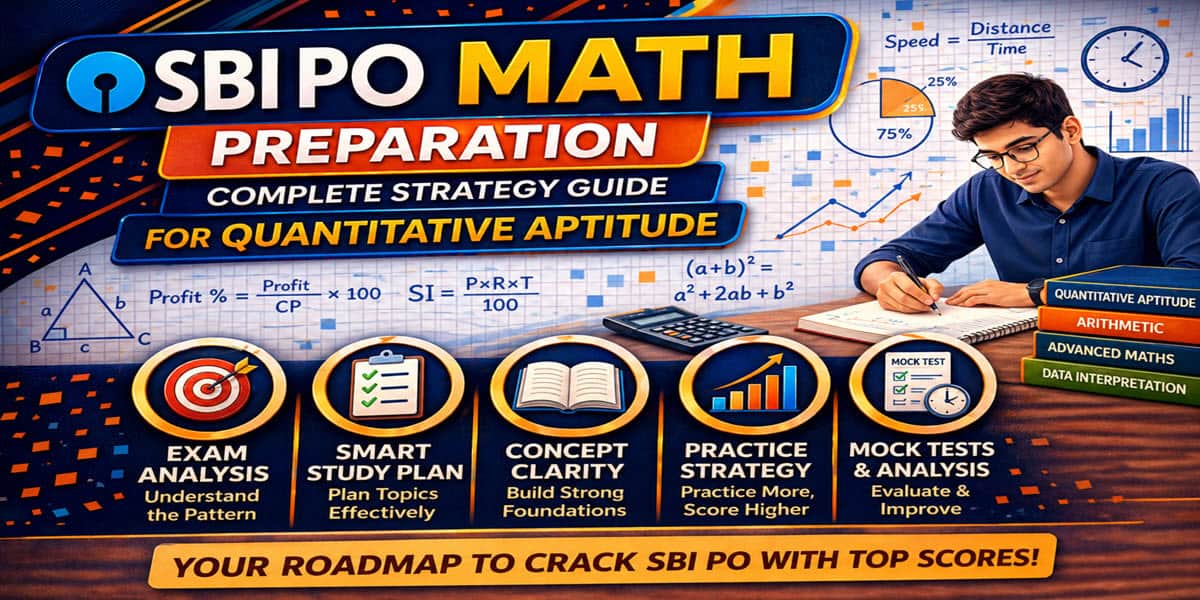
SBI PO is one of the most competitive banking examinations in India — with lakhs of candidates competing for a limited number of posts every year. The quantitative aptitude section separates serious candidates from the rest, and the margin between selection and rejection is often just 2–3 questions.
The good news: SBI PO math follows a predictable pattern. The same topic families appear every year — data interpretation, arithmetic, number series, and quadratic equations. The difficulty level is moderate in Prelims and significantly higher in Mains. A candidate who builds strong arithmetic fundamentals, masters DI calculation speed, and practices under timed conditions consistently can score 30+ out of 35 in Prelims and 40+ out of 50 in Mains.
This guide gives you the complete picture: exam pattern, topic-wise weightage, the right preparation sequence, shortcuts for every high-weightage topic, and a 60-day practice plan that builds from fundamentals to exam-level speed.
For foundational speed math skills, refer to our IBPS PO Quantitative Aptitude guide — the arithmetic techniques covered there apply directly to SBI PO as well.
Part 1: SBI PO Exam Pattern — Quantitative Aptitude
Prelims Pattern
| Section | Questions | Time |
|---|---|---|
| English Language | 40 | 20 min |
| Quantitative Aptitude | 30 | 20 min |
| Reasoning Ability | 30 | 20 min |
| Total | 100 | 60 min |
Key insight: 30 questions in 20 minutes = 30 seconds per question. Speed is non-negotiable.
Mains Pattern — Quantitative Aptitude
| Section | Questions | Marks | Time |
|---|---|---|---|
| Data Analysis and Interpretation | 30 | 60 | 45 min |
| Total (full paper) | 170 | 200 | 3 hours |
Key insight: Mains is purely DI-heavy. Arithmetic is embedded inside DI sets — not as standalone questions.
Part 2: Topic-Wise Weightage Analysis
Prelims — Topic Distribution
| Topic | Questions | Priority |
|---|---|---|
| Number Series | 5 | 🔴 Very High |
| Simplification / Approximation | 5 | 🔴 Very High |
| Data Interpretation | 5–10 | 🔴 Very High |
| Quadratic Equations | 5 | 🔴 Very High |
| Arithmetic (miscellaneous) | 10–15 | 🔴 High |
Arithmetic subcategories in miscellaneous:
- Percentage and profit-loss
- SI and CI
- Time-work and pipes-cisterns
- Speed-distance-time
- Ratio-proportion and partnership
- Age problems
- Average and mixture-alligation
Mains — Topic Distribution
| Topic | Questions | Priority |
|---|---|---|
| Data Interpretation (tables, graphs, caselet) | 20–25 | 🔴 Very High |
| Arithmetic Word Problems | 8–10 | 🔴 High |
| Data Sufficiency | 3–5 | 🟡 Medium |
| Quantity Comparison | 3–5 | 🟡 Medium |
Part 3: Number Series — 5 Quick Marks in Prelims
Number series contributes exactly 5 questions in SBI PO Prelims — and all 5 are solvable within 60 seconds each if you know the patterns.
The 6 Patterns to Master
Pattern 1 — Constant difference: 4, 9, 14, 19, _ → d=5 → 24
Pattern 2 — Increasing difference: 2, 3, 5, 8, 12, _ → differences 1,2,3,4,5 → 17
Pattern 3 — Multiplication ratio: 3, 6, 12, 24, _ → ×2 → 48
Pattern 4 — Squares/cubes ± constant: 1, 4, 9, 16, _ → n² → 25
Pattern 5 — Two alternating series: 1, 2, 3, 4, 5, 6, _ (odd positions: 1,3,5 | even: 2,4,6) → 7
Pattern 6 — Multiply + add/subtract: 1, 3, 7, 15, 31, _ → ×2+1 → 63
Worked Example 1:
Find missing term: 8, 27, 64, 125, ___
= 2³, 3³, 4³, 5³ → 6³ = 216
Worked Example 2:
Find missing term: 7, 12, 19, 28, 39, ___
Differences: 5, 7, 9, 11 → next difference = 13
Missing = 39 + 13 = 52
Part 4: Simplification and Approximation
5 questions — target: solve all 5 in under 4 minutes total (48 seconds each).
Simplification Rules
Apply BODMAS strictly: Brackets → Orders → Division → Multiplication → Addition → Subtraction.
Worked Example 3:
Simplify: 25% of 480 + 35% of 600 − 120
= 120 + 210 − 120 = 210
Approximation Strategy
Round to nearest convenient number — do not compute exact values.
Worked Example 4:
Approximate: 18.97% of 1249 + 32.1% of 799
≈ 19% of 1250 + 32% of 800
= 237.5 + 256 = 493.5 (choose closest option)
Key rule: For approximation — round up and down alternately to minimize cumulative error.
Part 5: Quadratic Equations
5 questions — each asking whether root of equation 1 is greater than, less than, or equal to root of equation 2.
Standard Method
Step 1: Factorize both equations.
Step 2: Find roots of each.
Step 3: Compare all root combinations.
Worked Example 5:
x² − 7x + 12 = 0 and y² − 5y + 6 = 0. Compare x and y.
x² − 7x + 12 = 0 → (x−3)(x−4) = 0 → x = 3 or 4
y² − 5y + 6 = 0 → (y−2)(y−3) = 0 → y = 2 or 3
Comparing all pairs:
x=3, y=2 → x>y
x=3, y=3 → x=y
x=4, y=2 → x>y
x=4, y=3 → x>y
x ≥ y
Shortcut — Signs Method
For ax² + bx + c = 0:
Sum of roots = −b/a
Product of roots = c/a
Use these to find roots quickly without full factorization when b and c are small.
Part 6: Data Interpretation — The Core of SBI PO
DI is the highest-weightage topic in both Prelims and Mains. Speed and accuracy here determines selection.
DI Types in SBI PO
| Type | Prelims | Mains |
|---|---|---|
| Bar Graph | ✅ | ✅ |
| Line Graph | ✅ | ✅ |
| Pie Chart | ✅ | ✅ |
| Table | ✅ | ✅ |
| Caselet (paragraph) | ✅ | ✅ |
| Mixed/Combined | ❌ | ✅ |
DI Speed Strategy
Step 1 — Read the data first (30 sec): Understand what each axis/column represents before reading questions.
Step 2 — Identify question type: Percentage, ratio, difference, average, growth rate.
Step 3 — Approximate where possible: For "approximately" questions — never compute exact values.
Worked Example 6 — Bar Graph DI:
Sales of company A in 2022 = 450 units, 2023 = 540 units. Find percentage growth.
Growth = (540−450)/450 × 100 = 90/450 × 100 = 20%
Worked Example 7 — Pie Chart DI:
Total revenue = Rs. 12,00,000. Product X = 25% of pie. Find revenue from X.
Revenue = 25% of 12,00,000 = Rs. 3,00,000
Caselet DI — Mains Specific
Caselet DI gives data in paragraph form. The skill is extraction — converting paragraph data into a table before solving.
For complete caselet strategy — refer to our Caselet DI guide.
Part 7: Arithmetic — Miscellaneous Section Strategy
10–15 arithmetic questions appear in Prelims. Each tests one topic — profit-loss, SI/CI, ratio, age, mixture, time-work, or speed-distance.
Topic-Wise Time Budget (Prelims)
| Topic | Target Time |
|---|---|
| Percentage / Profit-Loss | 45 sec |
| SI / CI | 60 sec |
| Ratio / Partnership | 45 sec |
| Time-Work / Pipes | 60 sec |
| Speed-Distance | 60 sec |
| Age Problems | 45 sec |
| Mixture-Alligation | 60 sec |
| Average | 30 sec |
Key Shortcuts for High-Frequency Topics
Profit-Loss: SP = CP × (100 ± P%)/100 — use multiplying factor directly.
CI for 2 years: CI = P × r/100 × (2 + r/100) — faster than computing year by year.
Time-Work: Total work = LCM of days. Convert to units/day. Add rates.
Mixture-Alligation: Use cross-subtraction diagram — (d₂−m):(m−d₁).
For detailed shortcuts on each topic — refer to the individual topic guides on SpeedMath.in.
Part 8: Attempt Strategy — Prelims
Recommended Question Attempt Order
| Round | Questions | Time |
|---|---|---|
| 1st | Simplification (5) + Number Series (5) | 5 min |
| 2nd | Quadratic Equations (5) | 4 min |
| 3rd | Easy arithmetic questions | 6 min |
| 4th | DI set (5–10) | 5 min |
| Total | 30–32 questions | 20 min |
Target: Attempt 30–32 questions with 90%+ accuracy.
Cut-off Awareness
SBI PO Prelims sectional cut-off for QA is typically 8–12 marks depending on year and category. Safe score = 25+ marks to clear comfortably and remain competitive for Mains.
Part 9: Mains Strategy
DI-First Approach
In Mains, attempt DI sets first — they carry maximum marks and reward candidates with good data reading skills. Target:
- 4 DI sets attempted = 20 questions
- 2 arithmetic sections = 8–10 questions
- Total: 28–30 questions in 45 minutes
Accuracy Over Attempts
In Mains, negative marking (0.25 per wrong answer) makes accuracy critical. Do not attempt questions where you are less than 80% confident. Leaving a question blank is better than a wrong answer that costs 0.25 marks.
60-Day SBI PO Math Practice Plan
| Days | Focus | Daily Time |
|---|---|---|
| 1–10 | Number series + simplification + approximation | 45 min |
| 11–20 | Quadratic equations + basic DI (tables, bar graphs) | 45 min |
| 21–30 | Arithmetic — percentage, profit-loss, SI/CI, ratio | 45 min |
| 31–40 | Arithmetic — time-work, speed-distance, mixtures, ages | 45 min |
| 41–50 | Advanced DI — pie charts, line graphs, caselet | 60 min |
| 51–60 | Full mock tests + weak topic revision + SpeedMath.in timed drills | 90 min |
Quick Reference — SBI PO QA at a Glance
| Prelims Target | 25+ out of 35 |
|---|---|
| Mains Target | 40+ out of 50 (approx) |
| Number Series | 5 questions — all attempt |
| Simplification | 5 questions — all attempt |
| Quadratic | 5 questions — all attempt |
| DI | 5–10 questions — high priority |
| Arithmetic | Attempt easy ones first |
| Time per question | 34 seconds (Prelims) |