
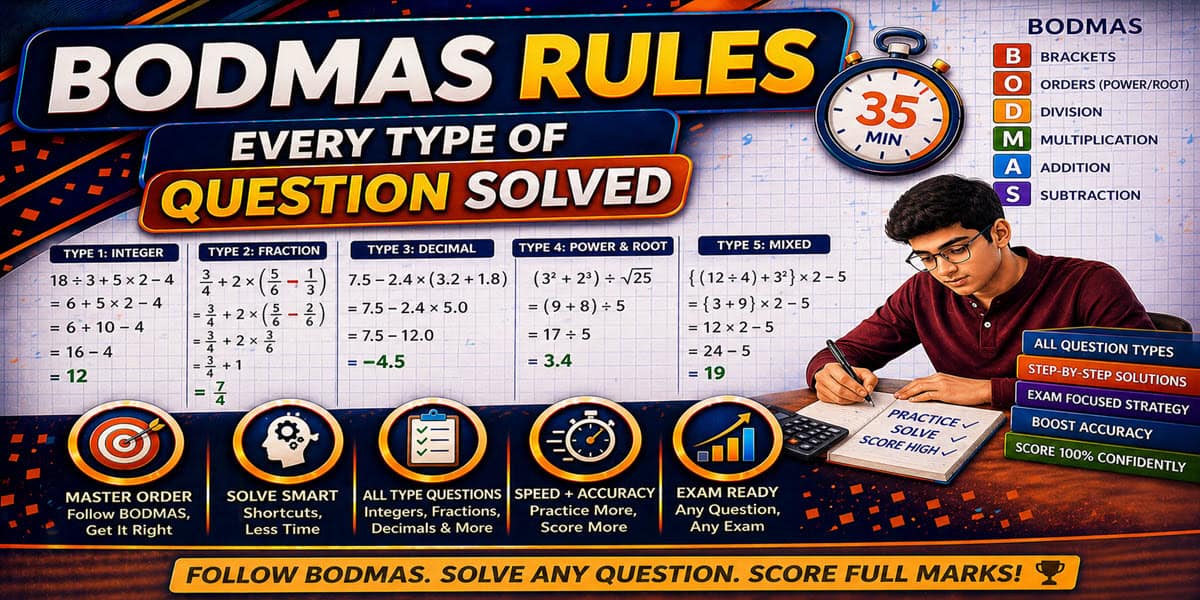
BODMAS is the rule that determines the order in which mathematical operations must be performed in any expression. Without it, the same expression can produce completely different answers depending on which operation you do first — and only one answer is correct.
The full form of BODMAS is: Brackets → Orders (powers and roots) → Division → Multiplication → Addition → Subtraction. In some countries and textbooks, the same rule is called PEMDAS (Parentheses, Exponents, Multiplication, Division, Addition, Subtraction) or BIDMAS — but the mathematical logic is identical.
BODMAS questions appear in every competitive exam in India — SSC CGL, SSC CHSL, IBPS, RRB, NTSE, Class 6 to 10 boards, and even entrance exams like CAT and GMAT. This guide covers every type of BODMAS question with full worked solutions, common mistakes, and exam-specific shortcuts.
Part 1: BODMAS — Complete Order Reference
The Full Hierarchy
| Priority | Operation | Symbol | Example |
|---|---|---|---|
| 1st | Brackets | ( ) { } [] | (3 + 4) |
| 2nd | Orders | Powers, roots | 3², √16 |
| 3rd | Division | ÷ or / | 12 ÷ 4 |
| 4th | Multiplication | × | 3 × 5 |
| 5th | Addition | + | 7 + 2 |
| 6th | Subtraction | − | 9 − 3 |
Bracket Hierarchy — Which Opens First
When multiple bracket types appear together, solve innermost first:
Order of bracket types (inner to outer):
Round brackets ( ) → Curly brackets { } → Square brackets []
Example structure: [ { ( ) }]
Solve ( ) first → then { } → then []
Division and Multiplication — Same Priority
When D and M appear together with no other priority difference, solve left to right.
12 ÷ 4 × 3 = 3 × 3 = 9 (NOT 12 ÷ 12 = 1)
Addition and Subtraction — Same Priority
When A and S appear together, solve left to right.
10 − 3 + 2 = 7 + 2 = 9 (NOT 10 − 5 = 5)
Part 2: Basic BODMAS — Step by Step
Level 1 — Simple Expressions
Worked Example 1:
Solve: 3 + 4 × 2
Step 1: No brackets or orders
Step 2: Multiplication first → 4 × 2 = 8
Step 3: Addition → 3 + 8 = 11
❌ Common mistake: 3 + 4 = 7, then 7 × 2 = 14 → Wrong!
Worked Example 2:
Solve: 20 − 4 ÷ 2 + 3
Step 1: Division → 4 ÷ 2 = 2
Step 2: Left to right → 20 − 2 + 3 = 18 + 3 = 21
Worked Example 3:
Solve: 5 × 3 + 8 ÷ 4 − 2
Step 1: Multiplication → 5 × 3 = 15
Step 2: Division → 8 ÷ 4 = 2
Step 3: Left to right → 15 + 2 − 2 = 15
Worked Example 4:
Solve: 18 ÷ 6 × 3 ÷ 9
D and M same priority → left to right:
18 ÷ 6 = 3 → 3 × 3 = 9 → 9 ÷ 9 = 1
Part 3: BODMAS with Brackets
Single Bracket
Worked Example 5:
Solve: (3 + 5) × 4 − 6
Step 1: Bracket → 3 + 5 = 8
Step 2: Multiply → 8 × 4 = 32
Step 3: Subtract → 32 − 6 = 26
Worked Example 6:
Solve: 50 ÷ (2 + 3) × 4
Step 1: Bracket → 2 + 3 = 5
Step 2: Left to right → 50 ÷ 5 = 10 → 10 × 4 = 40
Nested Brackets
Worked Example 7:
Solve: [3 + {4 × (2 + 1)} − 5]
Step 1: Innermost ( ) → 2 + 1 = 3
Step 2: { } → 4 × 3 = 12
Step 3: [] → 3 + 12 − 5 = 10
Worked Example 8:
Solve: 100 − [40 + {20 − (10 + 5)}]
Step 1: ( ) → 10 + 5 = 15
Step 2: { } → 20 − 15 = 5
Step 3: [] → 40 + 5 = 45
Step 4: Final → 100 − 45 = 55
Worked Example 9:
Solve: 3 × [4 + {6 − (2 × 1 + 1)}]
Step 1: ( ) → 2 × 1 = 2, then 2 + 1 = 3
Step 2: { } → 6 − 3 = 3
Step 3: [] → 4 + 3 = 7
Step 4: Final → 3 × 7 = 21
Part 4: BODMAS with Powers and Roots (Orders)
Powers and roots are solved immediately after brackets — before division, multiplication, addition, subtraction.
Worked Example 10:
Solve: 2 + 3² × 4
Step 1: Order → 3² = 9
Step 2: Multiply → 9 × 4 = 36
Step 3: Add → 2 + 36 = 38
❌ Common mistake: (2 + 3)² × 4 = 25 × 4 = 100 → only valid if brackets present
Worked Example 11:
Solve: √64 + 4² ÷ 8 − 3
Step 1: Orders → √64 = 8, 4² = 16
Step 2: Division → 16 ÷ 8 = 2
Step 3: Left to right → 8 + 2 − 3 = 7
Worked Example 12:
Solve: (2 + 3)² − 4 × 3 + √9
Step 1: Bracket → 2 + 3 = 5
Step 2: Orders → 5² = 25, √9 = 3
Step 3: Multiply → 4 × 3 = 12
Step 4: Left to right → 25 − 12 + 3 = 16
Worked Example 13:
Solve: 2³ + √(9 + 16) − 4²÷8
Step 1: Orders inside root → 9 + 16 = 25, √25 = 5
Step 2: Other orders → 2³ = 8, 4² = 16
Step 3: Division → 16 ÷ 8 = 2
Step 4: Left to right → 8 + 5 − 2 = 11
Part 5: BODMAS with Fractions
Fractions are treated as division — numerator ÷ denominator. The fraction bar also acts as a grouping symbol (bracket).
Rule: Fraction Bar = Invisible Bracket
(3 + 5) / (2 + 2) means (3+5) ÷ (2+2) — solve numerator and denominator separately first.
Worked Example 14:
Solve: (8 + 4) / (9 − 3)
Numerator = 12, Denominator = 6
Answer = 12/6 = 2
Worked Example 15:
Solve: 3 + 12/(2 × 3) − 1
Step 1: Fraction denominator → 2 × 3 = 6
Step 2: Fraction → 12/6 = 2
Step 3: Left to right → 3 + 2 − 1 = 4
Worked Example 16:
Solve: (5² − 3²) / (5 + 3) × 4
Step 1: Orders → 5² = 25, 3² = 9
Step 2: Numerator → 25 − 9 = 16
Step 3: Denominator → 5 + 3 = 8
Step 4: Fraction → 16/8 = 2
Step 5: Multiply → 2 × 4 = 8
Shortcut — Difference of squares: (5² − 3²) / (5 + 3) = (5−3)(5+3)/(5+3) = (5−3) = 2 → saves a step!
Worked Example 17 — Complex Fraction:
Solve: [3 × 4 + 2²] / [5² − (3 + 2²)]
Numerator: 3 × 4 = 12, 2² = 4 → 12 + 4 = 16
Denominator: 5² = 25, 2² = 4 → 3 + 4 = 7 → 25 − 7 = 18
Answer = 16/18 = 8/9
Part 6: BODMAS with Decimals
Decimals follow the exact same BODMAS order. The key is to keep decimal points aligned correctly.
Worked Example 18:
Solve: 3.5 + 2.5 × 4 − 1.2
Step 1: Multiply → 2.5 × 4 = 10
Step 2: Left to right → 3.5 + 10 − 1.2 = 12.3
Worked Example 19:
Solve: (4.8 + 1.2) ÷ 3 × 2.5
Step 1: Bracket → 4.8 + 1.2 = 6
Step 2: Left to right → 6 ÷ 3 = 2 → 2 × 2.5 = 5
Worked Example 20:
Solve: 0.5² × 8 + √0.64 − 1.2
Step 1: Orders → 0.5² = 0.25, √0.64 = 0.8
Step 2: Multiply → 0.25 × 8 = 2
Step 3: Left to right → 2 + 0.8 − 1.2 = 1.6
Part 7: BODMAS in Competitive Exam Questions
Competitive exams (SSC, IBPS, RRB) test BODMAS in three specific ways — direct simplification, missing number, and wrong number insertion.
Type 1 — Direct Simplification
Worked Example 21:
Simplify: 3/4 of 64 + 5/8 of 96 − 15% of 200
Step 1: "of" = multiplication → apply first
3/4 × 64 = 48
5/8 × 96 = 60
15/100 × 200 = 30
Step 2: Left to right → 48 + 60 − 30 = 78
Key rule: In competitive exams, "of" is treated as multiplication and solved at the Orders/Multiplication stage.
Worked Example 22:
Simplify: 25% of 400 + ⅓ of 270 − √225
Step 1: 25% of 400 = 100
Step 2: ⅓ of 270 = 90
Step 3: √225 = 15
Step 4: 100 + 90 − 15 = 175
Type 2 — Missing Number (? Questions)
Worked Example 23:
? + 3 × 4 = 50 − 2²
RHS: 2² = 4 → 50 − 4 = 46
LHS: 3 × 4 = 12 → ? + 12 = 46
? = 34
Worked Example 24:
144 ÷ ? × 3 = 36
144 ÷ ? = 12 (since 12 × 3 = 36)
? = 144 ÷ 12 = 12
Type 3 — Approximation (Competitive Exam Style)
Worked Example 25:
Approximate: 19.8% of 3995 + 4.9 × 79.8
≈ 20% of 4000 + 5 × 80
= 800 + 400 = 1200
Worked Example 26:
Approximate: √(399) × 5.02 + (14.97)²
≈ √400 × 5 + 15²
= 20 × 5 + 225
= 100 + 225 = 325
Part 8: Common BODMAS Mistakes — Avoid These
Mistake 1 — Ignoring Left-to-Right Rule
❌ Wrong: 12 ÷ 4 ÷ 3 = 12 ÷ 1 = 12
✅ Right: 12 ÷ 4 = 3, then 3 ÷ 3 = 1
Mistake 2 — Subtracting Before Adding
❌ Wrong: 10 + 5 − 8 = 10 + (5 − 8) = 10 − 3 = 7
✅ Right: 10 + 5 = 15, then 15 − 8 = 7 ← same here, but this fails when:
❌ Wrong: 10 − 5 + 8 = 10 − 13 = −3
✅ Right: 10 − 5 = 5, then 5 + 8 = 13
Mistake 3 — Forgetting "of" = Multiplication
❌ Wrong: ½ of 3 + 5 = ½ of 8 = 4
✅ Right: ½ × 3 = 1.5, then 1.5 + 5 = 6.5
Mistake 4 — Solving Power Inside vs Outside Bracket
❌ Wrong: 2 + 3² = 5² = 25
✅ Right: 3² = 9, then 2 + 9 = 11
Mistake 5 — Bar Fraction Not Treated as Bracket
❌ Wrong: 3 + 9/3 + 6 read as (3+9)/(3+6) = 12/9
✅ Right: 3 + (9/3) + 6 = 3 + 3 + 6 = 12 (slash is not a grouping bar)
Part 9: BODMAS Quick Reference — 20 Practice Questions
| # | Expression | Answer |
|---|---|---|
| 1 | 5 + 3 × 2 | 11 |
| 2 | (5 + 3) × 2 | 16 |
| 3 | 20 ÷ 4 + 3 × 2 | 11 |
| 4 | 4² − √16 + 3 | 15 |
| 5 | 3 × [2 + {5 − (1 + 1)}] | 18 |
| 6 | 100 − [30 + {10 + 5}] | 55 |
| 7 | ½ of 40 + ¼ of 60 | 35 |
| 8 | (3 + 2)² − 4 × 3 | 13 |
| 9 | 36 ÷ 6 ÷ 3 × 2 | 4 |
| 10 | √(25 + 144) − 3² | 4 |
| 11 | 15% of 200 + 25% of 80 | 50 |
| 12 | (7² − 1) / (6 + 2) | 6 |
| 13 | 2³ + 3² − 4 × 2 | 9 |
| 14 | 0.5 × 6 + 4.5 ÷ 9 | 3.5 |
| 15 | [5 × {3 + (8 − 6)}] − 4 | 21 |
| 16 | 48 ÷ 4 × 3 ÷ 9 | 4 |
| 17 | ⅔ of 90 − ¼ of 40 | 50 |
| 18 | (1.5)² × 4 + √9 | 12 |
| 19 | 3 + 4 × 5 − 6 ÷ 3 | 21 |
| 20 | [4² − {3 × (2 + 1)}] + 5 | 12 |