
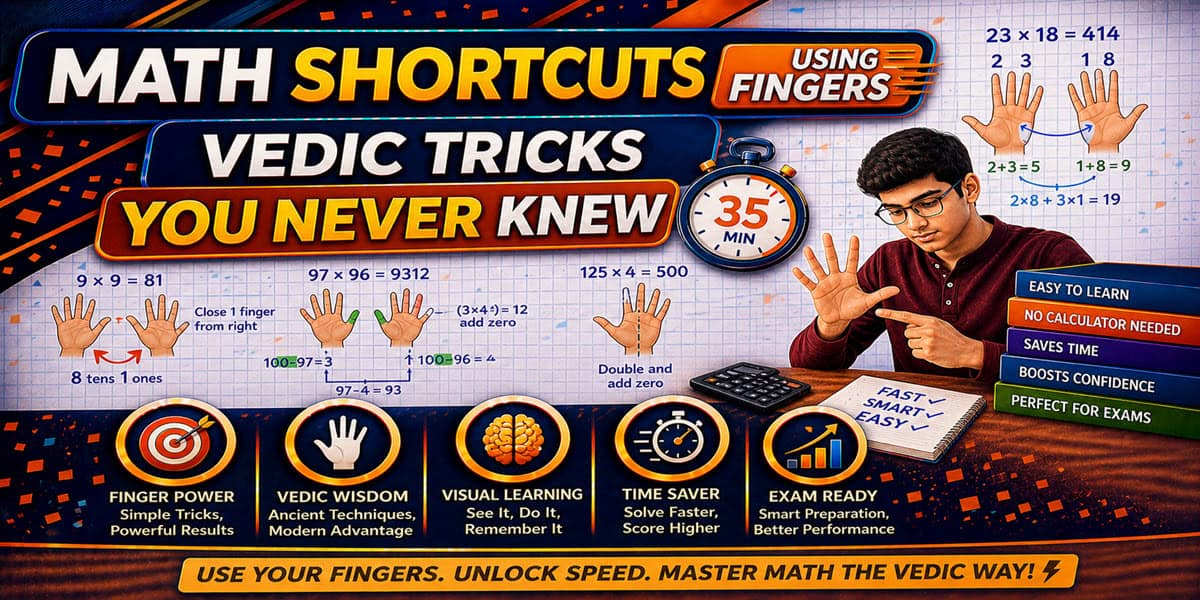
Most people use fingers only for counting to ten. But your hands are capable of multiplying large numbers, calculating square roots, remembering trigonometric values, and solving the 9 times table in seconds — all without a pen, paper, or calculator.
Finger math is not a gimmick. It is a genuine calculation system used by students in Japan, India, and China for centuries — and several of the techniques in this guide are directly rooted in Vedic Maths, the ancient Indian system of fast calculation that now forms the backbone of competitive exam shortcuts worldwide.
This guide teaches you every practical finger math trick — from the classic 9 times table trick to the advanced finger square method — with step-by-step instructions and worked examples you can try right now with your own hands.
Part 1: The Classic — 9 Times Table on Your Fingers
This is the most well-known finger trick, but most people only half-know it. Here is the complete method.
How It Works
Hold both hands in front of you, palms facing you, fingers spread. Number your fingers 1 to 10 from left to right — left thumb = 1, left index = 2... right index = 9, right thumb = 10.
To find 9 × n: Fold down finger number n.
- Fingers to the LEFT of the folded finger = tens digit
- Fingers to the RIGHT of the folded finger = units digit
Worked Examples
9 × 3:
Fold down finger 3 (left middle finger)
Left of folded = 2 fingers → tens = 2
Right of folded = 7 fingers → units = 7
Answer = 27 ✅
9 × 7:
Fold down finger 7 (right middle finger)
Left of folded = 6 fingers → tens = 6
Right of folded = 3 fingers → units = 3
Answer = 63 ✅
9 × 10:
Fold down finger 10 (right thumb)
Left = 9, Right = 0
Answer = 90 ✅
Why it works: 9 × n = 10(n−1) + (10−n) — the tens digit is always n−1 and units digit is always 10−n. Your fingers physically represent this split.
Part 2: 6 × 6 to 10 × 10 — The Universal Multiplication Trick
This trick lets you multiply any two numbers between 6 and 10 using only your fingers — no memorization of the upper times table needed.
Setup
Hold both hands in front of you, palms facing you.
On each hand, assign values to your fingers from bottom to top:
- Little finger = 6
- Ring finger = 7
- Middle finger = 8
- Index finger = 9
- Thumb = 10
Method — Step by Step
To multiply a × b (both between 6 and 10):
Step 1: Touch the finger representing a on your left hand to the finger representing b on your right hand. The two touching fingers and all fingers below them on both hands = tens digit group.
Step 2: Count the touching fingers + all fingers below = number of tens → multiply by 10.
Step 3: Count remaining fingers above the touching finger on LEFT hand. Count remaining fingers above on RIGHT hand. Multiply these two numbers together = units contribution.
Step 4: Add tens + units = final answer.
Worked Examples
8 × 7:
Touch middle finger (8) on left to ring finger (7) on right.
Below + touching: Left = 3 (middle, ring, little), Right = 2 (ring, little) → Total = 5 → 5 × 10 = 50
Above on left = 2 (index + thumb), Above on right = 3 (middle, index, thumb)
Units = 2 × 3 = 6
Answer = 50 + 6 = 56 ✅
9 × 6:
Touch index (9) left to little finger (6) right.
Below + touching: Left = 4, Right = 1 → Total = 5 → 50
Above left = 1 (thumb), Above right = 4 (ring, middle, index, thumb)
Units = 1 × 4 = 4
Answer = 50 + 4 = 54 ✅
7 × 7:
Touch ring (7) left to ring (7) right.
Below + touching: Left = 2, Right = 2 → Total = 4 → 40
Above left = 3, Above right = 3
Units = 3 × 3 = 9
Answer = 40 + 9 = 49 ✅
Note: When units product exceeds 9 (e.g., 6 × 6 gives 4 × 4 = 16), carry the tens of the units product into the tens: 20 + 16 = 36 ✅
Part 3: Trigonometry Values on Your Left Hand
This is the trick every Class 10, 11, and competitive exam student needs. Your left hand stores all standard sine and cosine values — 0°, 30°, 45°, 60°, 90°.
Setup
Hold your left hand, palm facing you, fingers spread.
Number your fingers from left (thumb) to right (little finger):
- Thumb = 0°
- Index = 30°
- Middle = 45°
- Ring = 60°
- Little = 90°
Finding sin of Any Standard Angle
Formula: sin(angle) = √(finger number) / 2
Where finger number = 0 for thumb, 1 for index, 2 for middle, 3 for ring, 4 for little.
To use: Fold down the finger for the angle you want. Count fingers on the LEFT side of folded finger (including folded) = finger number for sin.
- sin 0° = √0 / 2 = 0
- sin 30° = √1 / 2 = 1/2
- sin 45° = √2 / 2
- sin 60° = √3 / 2
- sin 90° = √4 / 2 = 1
Finding cos of Any Standard Angle
Formula: cos(angle) = √(fingers on RIGHT of folded finger) / 2
- cos 0° = √4 / 2 = 1
- cos 30° = √3 / 2
- cos 45° = √2 / 2
- cos 60° = √1 / 2 = 1/2
- cos 90° = √0 / 2 = 0
The elegant pattern: sin and cos are mirror images of each other — exactly as expected since cos θ = sin(90° − θ).
Finding tan
tan θ = sin θ / cos θ = √(left count) / √(right count)
- tan 30° = √1/√3 = 1/√3
- tan 45° = √2/√2 = 1
- tan 60° = √3/√1 = √3
Part 4: Vedic Finger Square — Square Any Number Ending in 5
This trick works for any number ending in 5 — 15², 25², 35², 45², 55², 65², 75², 85², 95², 105², 115², 125²...
The Rule
For any number n5 (ending in 5):
- Units always = 25
- Tens and above = n × (n + 1)
Worked Examples
25²:
n = 2 → 2 × 3 = 6
Answer = 625
35²:
n = 3 → 3 × 4 = 12
Answer = 1225
75²:
n = 7 → 7 × 8 = 56
Answer = 5625
105²:
n = 10 → 10 × 11 = 110
Answer = 11025
125²:
n = 12 → 12 × 13 = 156
Answer = 15625
Speed: With practice, any n5² can be solved in under 3 seconds mentally — no fingers needed, but the finger counting of n × (n+1) can be used for verification.
Part 5: The Vedic Complement Method — Multiply Near 100
For numbers close to 100 (85–115), this method is faster than traditional multiplication.
The Rule
To multiply a × b where both are near 100:
- Find deficit/surplus: d_a = a − 100, d_b = b − 100
- Answer = (a + d_b) × 100 + d_a × d_b
- Simplified: Cross-add one number with other's deviation, then multiply deviations
Worked Examples
97 × 96:
Deviations: −3 and −4
Cross: 97 − 4 = 93 (or 96 − 3 = 93) → 9300
Multiply deviations: (−3) × (−4) = 12
Answer = 9300 + 12 = 9312 ✅
103 × 108:
Deviations: +3 and +8
Cross: 103 + 8 = 111 → 11100
Multiply: 3 × 8 = 24
Answer = 11100 + 24 = 11124 ✅
97 × 104:
Deviations: −3 and +4
Cross: 97 + 4 = 101 → 10100
Multiply: (−3) × (+4) = −12
Answer = 10100 − 12 = 10088 ✅
Finger use: Use fingers to hold the deviation values (−3, +4) while doing the cross-addition mentally — prevents forgetting values mid-calculation.
Part 6: Finger Counting for Divisibility Rules
Your fingers can hold divisibility checks for the 7 most common divisors in competitive exams.
Divisibility Rules — Finger Memory Map
Assign one finger per rule, left hand little finger to right hand little finger:
| Finger | Divisor | Rule |
|---|---|---|
| Left little | 2 | Last digit even |
| Left ring | 3 | Sum of digits divisible by 3 |
| Left middle | 4 | Last 2 digits divisible by 4 |
| Left index | 5 | Last digit 0 or 5 |
| Left thumb | 6 | Divisible by both 2 and 3 |
| Right index | 8 | Last 3 digits divisible by 8 |
| Right middle | 9 | Sum of digits divisible by 9 |
| Right ring | 11 | Alternating digit sum = 0 or multiple of 11 |
Worked Examples
Is 4,572 divisible by 11?
Alternating sum = 4 − 5 + 7 − 2 = 4 → Not divisible by 11 ✗
Is 3,168 divisible by 8?
Last 3 digits = 168 → 168/8 = 21 → Yes ✅
Is 7,326 divisible by 6?
Last digit 6 → divisible by 2 ✅
Digit sum = 18 → divisible by 3 ✅
∴ Divisible by 6 ✅
Part 7: The Japanese Soroban — Finger Abacus Concept
The Japanese soroban (abacus) is taught to children as a finger-based mental calculation system. The key insight is that each finger represents a column of a mental abacus — units, tens, hundreds.
Simplified Finger Abacus — Addition
For adding two 2-digit numbers mentally:
Step 1: Use left hand fingers to hold the tens digit of running total
Step 2: Use right hand fingers to hold the units digit
Step 3: When units exceed 9, carry one to left hand
Example: 47 + 36
Start: Left = 4 (tens), Right = 7 (units)
Add 3 tens: Left = 4 + 3 = 7
Add 6 units: Right = 7 + 6 = 13 → carry 1 to left
Left = 7 + 1 = 8, Right = 3
Answer = 83 ✅
This technique is the foundation of how Japanese schoolchildren solve 3-digit additions mentally at remarkable speed — the fingers serve as external working memory.
Part 8: Chisanbop — Korean Finger Counting System
Chisanbop is a Korean finger counting method that allows counting and calculation from 0 to 99 using both hands.
Assignment
Right hand (units 0–9):
- Each finger = 1
- Thumb = 5
- All fingers + thumb = 9
Left hand (tens 0–90):
- Each finger = 10
- Thumb = 50
- All fingers + thumb = 90
How to Count
Press fingers down to "activate" their value. Total = sum of all pressed fingers.
| Value | Fingers Pressed |
|---|---|
| 7 | Right thumb (5) + right index + ring (2) |
| 23 | Left index + ring (20) + right thumb (5) − index (→ 3) |
| 58 | Left thumb (50) + left ring (8)... wait → Left thumb (50) + right thumb (5) + right index+middle+ring (3) |
Competitive exam use: Chisanbop is not used directly in exams, but training with it builds the proprioceptive number sense that makes mental arithmetic feel physical and automatic — reducing cognitive load during timed exams.
Part 9: Finger Tricks for Competitive Exams — Direct Application
| Exam | Trick | Where It Helps |
|---|---|---|
| SSC CGL / CHSL | 9× finger trick | Quick multiplication checks |
| Class 10 Boards | Trig finger (sin/cos table) | MCQ standard value recall |
| IBPS / RRB | Divisibility finger map | Number System questions |
| NTSE / Olympiad | n5² squaring trick | Speed calculation |
| Any MCQ exam | Complement method | Multiplication near 100 |
| Mental math | 6–10 multiplication | Times table above 6 |