
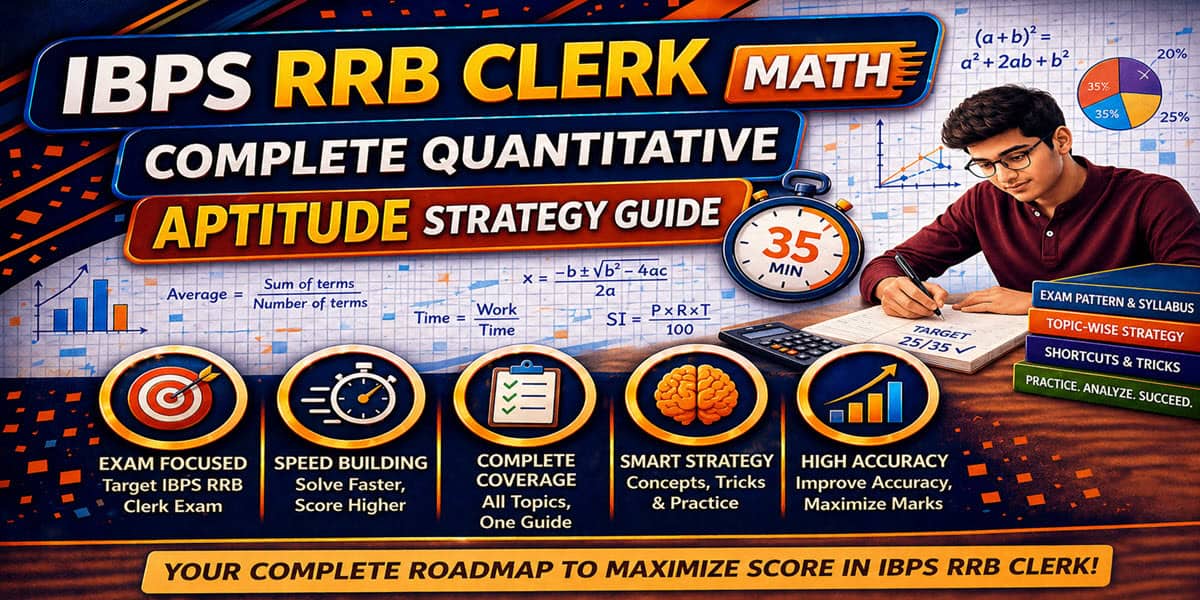
IBPS RRB Clerk — officially known as IBPS RRB Office Assistant — is conducted by IBPS for recruitment to clerical posts in Regional Rural Banks across India. It is one of the most accessible banking exams for freshers, with a moderate difficulty level and a straightforward exam pattern that rewards consistent arithmetic preparation.
The quantitative aptitude section in RRB Clerk Prelims contains 40 questions in 45 minutes total (shared with Reasoning) — making it the fastest-paced of all banking clerk exams. In Mains, QA expands to 40 questions carrying 50 marks with a dedicated 30-minute window. The topics are identical to other banking exams — simplification, number series, arithmetic, and DI — but the difficulty is moderate, making it an ideal exam for candidates building banking exam confidence.
This guide gives you the complete IBPS RRB Clerk math preparation strategy — exam pattern, topic-wise weightage, shortcuts, worked examples, attempt strategy, and a 45-day practice plan. For RRB PO-level strategy, refer to our RRB PO Math guide. For IBPS Clerk comparison, refer to our IBPS Clerk Math guide.
Part 1: IBPS RRB Clerk Exam Pattern — Quantitative Aptitude
Prelims Pattern
| Section | Questions | Marks | Time |
|---|---|---|---|
| Reasoning Ability | 40 | 40 | 45 min (combined) |
| Numerical Ability | 40 | 40 | 45 min (combined) |
| Total | 80 | 80 | 45 min |
Key insight: Both sections share 45 minutes — no sectional time limit. Allocate approximately 20–22 minutes to Numerical Ability.
Pace: 40 questions in 22 minutes = 33 seconds per question — fastest pace of any banking clerk exam.
Mains Pattern
| Section | Questions | Marks | Time |
|---|---|---|---|
| Reasoning | 40 | 50 | 30 min |
| Quantitative Aptitude | 40 | 50 | 30 min |
| General Awareness | 40 | 40 | 25 min |
| English / Hindi Language | 40 | 40 | 25 min |
| Computer Knowledge | 40 | 20 | 10 min |
| Total | 200 | 200 | 120 min |
Key insight: 40 QA questions in 30 minutes = 45 seconds per question.
Negative marking: 0.25 marks per wrong answer in both Prelims and Mains.
Part 2: Topic-Wise Weightage
Prelims — 40 Questions Distribution
| Topic | Questions | Priority |
|---|---|---|
| Simplification / Approximation | 5–10 | 🔴 Very High |
| Number Series | 5 | 🔴 Very High |
| Data Interpretation | 5–10 | 🔴 Very High |
| Arithmetic Word Problems | 15–20 | 🔴 Very High |
Arithmetic subcategories in Prelims:
- Percentage and profit-loss (2–3 questions)
- SI and CI (2 questions)
- Time-Work and Pipes and Cisterns (2 questions)
- Speed, Distance and Time + Boats and Streams (2–3 questions)
- Ratio, Proportion and Mixture (1–2 questions)
- Average and Age Problems (1–2 questions)
- Partnership (1 question)
Mains — 40 Questions Distribution
| Topic | Questions | Priority |
|---|---|---|
| Data Interpretation | 10–15 | 🔴 Very High |
| Arithmetic Word Problems | 10–15 | 🔴 Very High |
| Number Series | 5 | 🔴 High |
| Simplification / Approximation | 5 | 🔴 High |
| Quadratic Equations | 0–5 | 🟡 Medium |
| Data Sufficiency | 0–5 | 🟡 Medium |
Part 3: Simplification and Approximation — Fastest Scoring Block
5–10 simplification questions in Prelims — target all correct in under 7 minutes.
BODMAS — Core Application
Worked Example 1:
Simplify: 5/8 of 640 + 3/7 of 441 − 120
= 400 + 189 − 120 = 469
Worked Example 2:
Simplify: (√900 + ³√343) × 8 − 5²
= (30 + 7) × 8 − 25
= 37 × 8 − 25
= 296 − 25 = 271
Approximation — Speed First
Worked Example 3:
Approximate: 19.8% of 2505 + 14.9% of 3996
≈ 20% of 2500 + 15% of 4000
= 500 + 600 = 1,100
Worked Example 4:
Approximate: √(2025) × 12.97 + (18.02)²
= 45 × 13 + 324
= 585 + 324 = 909
Must-Know Values
Common fraction conversions:
1/8 = 12.5%, 3/8 = 37.5%, 5/8 = 62.5%, 7/8 = 87.5%
1/6 = 16.67%, 5/6 = 83.33%
Perfect square roots:
√441=21, √484=22, √529=23, √576=24, √625=25, √676=26, √729=27, √784=28, √841=29, √900=30
Part 4: Number Series — 5 Easy Marks
RRB Clerk number series is moderate — slightly easier than RRB PO. Master wrong number series as it appears frequently in Mains.
Worked Example 5:
Find missing: 3, 5, 9, 17, 33, ___
Pattern: ×2−1 each time
33×2−1 = 65
Worked Example 6:
Find missing: 100, 96, 88, 72, ___
Differences: 4, 8, 16 → next = 32
72−32 = 40
Worked Example 7 — Wrong Number Series:
Find wrong term: 8, 12, 24, 46, 96, 192
Pattern: ×1.5, ×2, ×2, ×2, ×2
8×1.5=12, 12×2=24, 24×2=48, 48×2=96, 96×2=192
46 is wrong — should be 48
Worked Example 8:
Find missing: 1, 4, 9, 16, 25, ___
Pattern: 1², 2², 3², 4², 5² → 6² = 36
Part 5: Arithmetic — Complete Topic Coverage
Percentage and Profit-Loss
Worked Example 9:
A fruit seller buys 100 mangoes for Rs. 400 and sells at Rs. 5 each. Profit%?
CP per mango = 4, SP per mango = 5
Profit% = 1/4 × 100 = 25%
Worked Example 10:
A shopkeeper gives 10% discount on marked price and still earns 8% profit. If CP = Rs. 900, find MP.
SP = 900 × 1.08 = 972
MP × 0.90 = 972
MP = 972/0.90 = Rs. 1,080
Simple and Compound Interest
Worked Example 11:
A sum doubles in 10 years at SI. In how many years will it triple?
Rate = 100/(P×10) × P = 10% per year
To triple: SI = 2P → 2P = P×10×T/100 → T = 20 years
Worked Example 12:
Find CI on Rs. 6,000 at 10% per annum for 2 years compounded annually.
A = 6000 × (1.1)² = 6000 × 1.21 = 7260
CI = 7260 − 6000 = Rs. 1,260
Time and Work + Pipes and Cisterns
Worked Example 13:
A and B can complete work in 12 and 16 days. They work together for 4 days then A leaves. How many more days for B?
LCM(12,16) = 48 units
A = 4 units/day, B = 3 units/day
Work in 4 days together = 4 × 7 = 28 units
Remaining = 20 units
B alone = 20/3 = 6.67 days
Worked Example 14 — Pipes:
Inlet pipe fills tank in 8 hours, outlet empties in 12 hours. Both open together — time to fill?
Net rate = 1/8 − 1/12 = 3/24 − 2/24 = 1/24
Time = 24 hours
For complete pipes and cisterns coverage — refer to our Pipes and Cisterns guide.
Speed, Distance, Time + Boats and Streams
Worked Example 15:
Speed of boat in still water = 15 km/h, stream speed = 5 km/h. Time to go 40 km downstream?
Downstream speed = 15+5 = 20 km/h
Time = 40/20 = 2 hours
Worked Example 16:
A man rows upstream 12 km in 3 hours and downstream 18 km in 3 hours. Find stream speed.
Upstream speed = 4 km/h, Downstream speed = 6 km/h
Stream speed = (6−4)/2 = 1 km/h
Ratio, Mixture and Alligation
Worked Example 17:
Alloy A has gold:silver = 3:2. Alloy B has gold:silver = 4:3. Mixed in ratio 1:2. Find gold% in mixture.
Alloy A gold fraction = 3/5
Alloy B gold fraction = 4/7
Mixed 1:2 → gold = 1×(3/5) + 2×(4/7) / 3
= (3/5 + 8/7) / 3
= (21/35 + 40/35) / 3
= (61/35) / 3 = 61/105 = 58.1%
Average and Age
Worked Example 18:
Average of 5 numbers is 36. If each number is increased by 5, new average?
New average = 36 + 5 = 41
*(When same value added to all — average increases by that value)*
Worked Example 19:
Ratio of present ages of P and Q is 5:7. After 6 years ratio = 3:4. Find present ages.
5k+6 / 7k+6 = 3/4
20k+24 = 21k+18
k = 6
P = 30, Q = 42 years
Part 6: Data Interpretation — Mains Core
DI contributes 10–15 questions in Mains — the highest single block.
DI Types in RRB Clerk
| Type | Prelims | Mains |
|---|---|---|
| Bar Graph | ✅ | ✅ |
| Table | ✅ | ✅ |
| Line Graph | ✅ | ✅ |
| Pie Chart | ✅ | ✅ |
| Missing Table DI | ❌ | ✅ |
| Mixed DI | ❌ | ✅ |
DI Worked Example — Bar Graph
Monthly sales (units): Jan=400, Feb=350, Mar=500, Apr=450, May=600
Q1: Average monthly sales?
= (400+350+500+450+600)/5 = 2300/5 = 460 units
Q2: Sales in Mar as % of total?
= 500/2300 × 100 = 21.74%
Q3: Highest growth month?
Jan→Feb: −50 (decline)
Feb→Mar: +150/350 = 42.86%
Mar→Apr: −50 (decline)
Apr→May: +150/450 = 33.33%
Feb→Mar had highest growth at 42.86%
Part 7: Attempt Strategy
Prelims — 22-Minute QA Plan
| Round | Topic | Questions | Time |
|---|---|---|---|
| 1st | Simplification (all) | 5–10 | 6 min |
| 2nd | Number Series (all) | 5 | 3 min |
| 3rd | DI set | 5–10 | 5 min |
| 4th | Easy arithmetic | 8–10 | 6 min |
| 5th | Remaining | 2–3 | 2 min |
| Total | 28–32 | 22 min |
Target Prelims: 28–32 attempts with 85%+ accuracy = 24–27 marks out of 40.
Mains — 30-Minute QA Plan
| Round | Topic | Questions | Time |
|---|---|---|---|
| 1st | Simplification + Number Series | 10 | 7 min |
| 2nd | DI sets (2 sets) | 10–15 | 12 min |
| 3rd | Arithmetic word problems | 10–12 | 9 min |
| 4th | Quadratic/DS if time allows | 3–5 | 2 min |
Target Mains: 30–34 attempts with 85%+ accuracy = 25–29 marks out of 50.
Cut-Off Awareness
RRB Clerk Prelims QA cut-off: typically 12–16 marks (varies by state)
Safe Prelims QA score: 24+ marks out of 40.
RRB Clerk Mains is the final selection stage — no interview.
Safe Mains QA score: 25+ marks out of 50.
45-Day IBPS RRB Clerk Math Practice Plan
| Days | Focus | Daily Time |
|---|---|---|
| 1–7 | Simplification + Approximation + Squares/Cube roots | 40 min |
| 8–14 | Number Series — all patterns + wrong term | 30 min |
| 15–21 | Percentage + Profit-Loss + SI/CI | 45 min |
| 22–28 | Time-Work + Pipes + Speed-Distance + Boats-Streams | 45 min |
| 29–35 | Ratio + Average + Age + Partnership | 35 min |
| 36–40 | DI — Bar Graph, Table, Pie Chart, Line Graph | 50 min |
| 41–45 | Full mock tests + SpeedMath.in timed drills | 90 min |
Quick Reference — RRB Clerk QA at a Glance
| Prelims Target | 24+ out of 40 |
|---|---|
| Mains Target | 25+ out of 50 |
| Simplification | 5–10 questions — all attempt |
| Number Series | 5 questions — all attempt |
| DI | 5–15 questions — high priority |
| Arithmetic | Easy ones first |
| Time per question | 33 sec (Prelims), 45 sec (Mains) |
| Negative marking | 0.25 per wrong |
| Mains = Final | No interview for Clerk |