
IBPS Clerk — conducted by the Institute of Banking Personnel Selection — is one of the largest banking recruitment examinations in India, filling thousands of clerical cadre vacancies across public sector banks every year. With a massive applicant pool and limited seats, even a single mark difference can determine whether a candidate qualifies for Mains or misses out entirely.
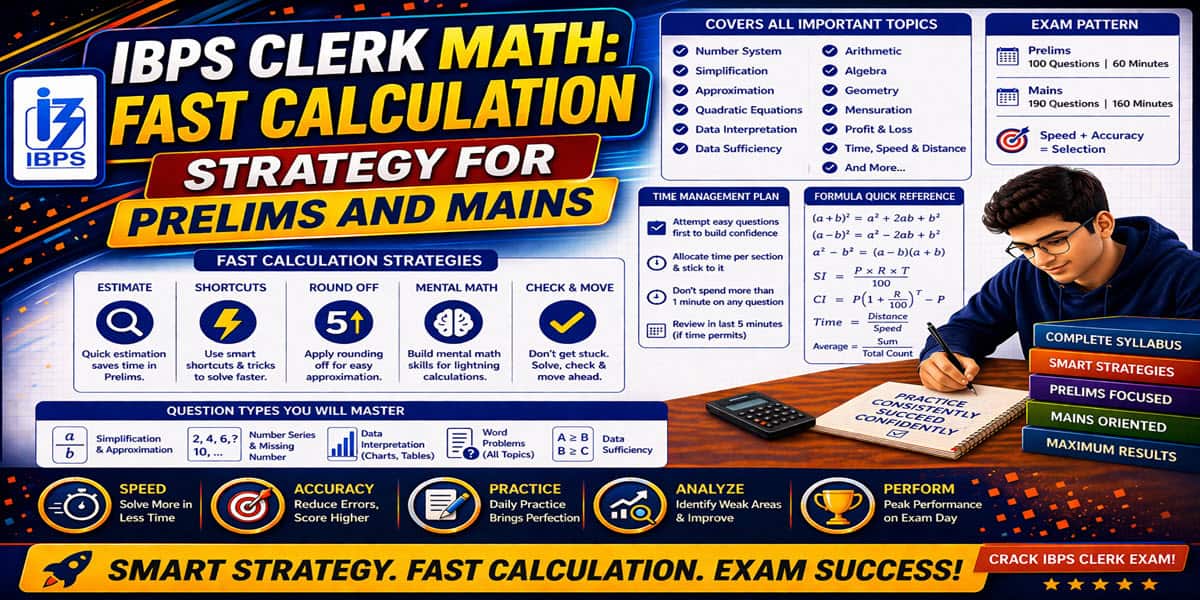
The quantitative aptitude section in IBPS Clerk Prelims contains 35 questions in 20 minutes — identical in structure to SBI Clerk Prelims. The difficulty level is moderate, but the speed requirement is unforgiving: 34 seconds per question leaves no room for lengthy calculations. In Mains, the section expands to 40 questions in 45 minutes, with higher difficulty and data interpretation sets that reward candidates who have built strong arithmetic reflexes.
This guide gives you the complete IBPS Clerk math preparation strategy — exam pattern, topic-wise weightage, fast calculation shortcuts, worked examples for every question type, attempt strategy, and a 45-day practice plan. For SBI Clerk comparison, refer to our SBI Clerk Math guide. For IBPS PO-level strategy, refer to our IBPS PO Quantitative Aptitude guide.
Part 1: IBPS Clerk Exam Pattern — Quantitative Aptitude
Prelims Pattern
| Section | Questions | Marks | Time |
|---|---|---|---|
| English Language | 30 | 30 | 20 min |
| Numerical Ability | 35 | 35 | 20 min |
| Reasoning Ability | 35 | 35 | 20 min |
| Total | 100 | 100 | 60 min |
Sectional time limit: Each section has a fixed 20-minute window — you cannot carry over time from one section to another.
Key insight: 35 questions in exactly 20 minutes = 34 seconds per question. No flexibility.
Mains Pattern
| Section | Questions | Marks | Time |
|---|---|---|---|
| General/Financial Awareness | 50 | 50 | 35 min |
| English Language | 40 | 40 | 35 min |
| Reasoning Ability and Computer Aptitude | 50 | 60 | 45 min |
| Quantitative Aptitude | 40 | 50 | 45 min |
| Total | 190 | 200 | 160 min |
Key insight: 40 QA questions in 45 minutes = 67 seconds per question. Harder questions but more time.
Negative marking: 0.25 marks per wrong answer in both Prelims and Mains.
Part 2: Topic-Wise Weightage
Prelims — 35 Questions Distribution
| Topic | Questions | Priority |
|---|---|---|
| Simplification / Approximation | 10–15 | 🔴 Very High |
| Number Series | 5 | 🔴 Very High |
| Arithmetic Word Problems | 15–20 | 🔴 Very High |
Arithmetic subcategories:
- Percentage and profit-loss (3–4 questions)
- SI and CI (1–2 questions)
- Time-Work and Pipes (1–2 questions)
- Speed-Distance-Time (1–2 questions)
- Ratio-Proportion and Mixture (1–2 questions)
- Average (1–2 questions)
- Age and Miscellaneous (1–2 questions)
Mains — 40 Questions Distribution
| Topic | Questions | Priority |
|---|---|---|
| Data Interpretation | 10–15 | 🔴 Very High |
| Arithmetic Word Problems | 15–18 | 🔴 Very High |
| Simplification | 5–8 | 🔴 High |
| Number Series | 5 | 🔴 High |
| Quadratic Equations | 5 | 🟡 Medium |
Part 3: Simplification — Master the Fastest 10–15 Marks
Simplification is the highest-scoring block in IBPS Clerk Prelims. Target: all questions correct in under 10 minutes.
Key Calculation Tools
Fraction-Decimal Equivalents:
| Fraction | Decimal | Percentage |
|---|---|---|
| 1/4 | 0.25 | 25% |
| 1/8 | 0.125 | 12.5% |
| 3/8 | 0.375 | 37.5% |
| 5/8 | 0.625 | 62.5% |
| 1/6 | 0.1667 | 16.67% |
| 1/3 | 0.3333 | 33.33% |
| 2/3 | 0.6667 | 66.67% |
Worked Example 1:
Simplify: 62.5% of 256 + 33.33% of 432 − 85
= 5/8 × 256 + 1/3 × 432 − 85
= 160 + 144 − 85 = 219
Worked Example 2:
Simplify: (√784 + ³√512) × 5 − 4²
= (28 + 8) × 5 − 16
= 36 × 5 − 16
= 180 − 16 = 164
Worked Example 3:
Approximate: 44.98% of 1602 + 24.9% of 4001 − 802
≈ 45% of 1600 + 25% of 4000 − 800
= 720 + 1000 − 800 = 920
Simplification Speed Drill — Daily Targets
| Day | Target | Time |
|---|---|---|
| Week 1 | 10 simplification in 12 min | Slow — accuracy first |
| Week 2 | 10 in 9 min | Building pace |
| Week 3 | 10 in 7 min | Exam pace |
| Week 4 | 15 in 10 min | Full Prelims simulation |
Part 4: Number Series — 5 Free Marks
IBPS Clerk number series is standard banking pattern — master all 6 types.
Worked Example 4:
Find missing: 4, 9, 25, 49, 121, ___
Pattern: 2², 3², 5², 7², 11² → prime squares
Next prime = 13 → 13² = 169
Worked Example 5:
Find missing: 7, 8, 18, 57, ___
Pattern: ×1+1, ×2+2, ×3+3, ×4+4
57×4+4 = 228+4 = 232
Worked Example 6:
Find wrong term: 2, 5, 10, 17, 26, 37, 50, 65
Pattern: +3, +5, +7, +9, +11, +13, +15 (odd differences)
2,5,10,17,26,37,50,65 — check:
37+13=50 ✓, 50+15=65 ✓
But 26+11=37 ✓, 17+9=26 ✓
All correct — no wrong term in this series.
Worked Example 7:
Find missing: 13, 14, 30, 93, ___
×1+1=14, ×2+2=30, ×3+3=93, ×4+4=?
93×4+4 = 372+4 = 376
Part 5: Arithmetic — Topic-Wise Shortcuts
Percentage — Two Key Shortcuts
Shortcut 1 — Percentage increase/decrease:
If value increases by a% then decreases by a%:
Net change = −a²/100% (always a loss)
Example: Value increases 20% then decreases 20%:
Net = −400/100 = −4% (net loss)
Shortcut 2 — Percentage of percentage:
x% of y = y% of x
Example: 8% of 75 = 75% of 8 = 6
*(75% of 8 = 6 is instant — faster than 8% of 75)*
Worked Example 8:
In an election, winner gets 60% of votes and wins by 2400 votes. Total votes?
Winner = 60%, Loser = 40%
Difference = 20% = 2400
Total = 2400/0.20 = 12,000 votes
Profit and Loss — Shortcut Table
| Scenario | Formula |
|---|---|
| Markup then discount | Net% = m + d + md/100 (d is negative) |
| Two articles same SP, one profit x% one loss x% | Always overall loss = x²/100% |
| False weight used | Profit% = (True − False)/False × 100 |
Worked Example 9:
A sells two items at Rs. 1200 each. On one he gains 20%, on other loses 20%. Net result?
Loss% = 20²/100 = 4% net loss
Net SP = 2400
CP = 2400/0.96 = 2500
Loss = 2500 − 2400 = Rs. 100
Simple and Compound Interest
Worked Example 10:
Rs. 12,000 invested at 8% SI for 3 years and Rs. 15,000 at 6% CI for 2 years. Find total interest.
SI = 12000×8×3/100 = Rs. 2,880
CI = 15000×(1.06)²−15000 = 15000×1.1236−15000 = 16854−15000 = Rs. 1,854
Total = Rs. 4,734
Time and Work — Efficiency Method
Worked Example 11:
A is 50% more efficient than B. Together they finish in 18 days. How long does A take alone?
Let B = 2 units/day → A = 3 units/day
Together = 5 units/day
Total work = 5 × 18 = 90 units
A alone = 90/3 = 30 days
Worked Example 12:
12 men can do work in 24 days. After 8 days 4 men join. How many more days to finish?
Total = 12×24 = 288 units
Done in 8 days = 12×8 = 96 units
Remaining = 192 units
New strength = 16 men
Days = 192/16 = 12 more days
Speed, Distance and Time
Worked Example 13:
Ratio of speeds of A and B is 3:4. A takes 20 min more than B to cover same distance. Find time taken by A.
Let B takes t min → A takes t+20 min
Speed ratio = 3:4 → Time ratio = 4:3 (inverse)
(t+20)/t = 4/3
3t+60 = 4t → t = 60
A takes = 60+20 = 80 minutes
Mixture and Alligation
Worked Example 14:
In what ratio should water be mixed with juice costing Rs. 24/litre to get mixture worth Rs. 20/litre?
By alligation:
Juice (24) ←→ Water (0)
Mean = 20
Water part = 24−20 = 4
Juice part = 20−0 = 20
Ratio water:juice = 4:20 = 1:5
Part 6: Data Interpretation — Mains Strategy
10–15 DI questions in Mains. IBPS Clerk Mains DI is moderate — tables, bar graphs, and pie charts dominate.
DI Approach — 4 Steps
Step 1 — Scan data (20 sec): Read all labels, units, and totals.
Step 2 — Read all questions first: Identify which questions share common calculations.
Step 3 — Calculate shared values once: Reuse across questions.
Step 4 — Approximate when allowed: "Approximately" = round aggressively.
DI Worked Example — Pie Chart
Total expenditure = Rs. 60,000
Food = 30%, Rent = 25%, Education = 20%, Transport = 15%, Others = 10%
Q1: Expenditure on Food?
= 30% of 60,000 = Rs. 18,000
Q2: Ratio of Rent to Transport?
= 25:15 = 5:3
Q3: Education + Others together?
= 30% of 60,000 = Rs. 18,000
Q4: If total increases by 10%, new rent expenditure?
New total = 66,000
Rent = 25% of 66,000 = Rs. 16,500
Part 7: Attempt Strategy
Prelims — Strict 20-Minute Plan
| Round | Questions | Target Time |
|---|---|---|
| Simplification (all) | 10–15 | 8 min |
| Number Series (all) | 5 | 3 min |
| Easy arithmetic (percentage, average, age) | 8–10 | 6 min |
| Remaining if time permits | 2–3 | 3 min |
| Total attempts | 25–30 | 20 min |
Do not spend more than 50 seconds on any single question in Prelims.
Mains — 45-Minute Plan
| Round | Questions | Time |
|---|---|---|
| Simplification (all) | 5–8 | 5 min |
| Number Series (all) | 5 | 4 min |
| DI sets (2–3 sets) | 10–15 | 18 min |
| Arithmetic word problems | 12–15 | 15 min |
| Quadratic equations | 3–5 | 3 min |
Target Prelims: 25–28 attempts, 88%+ accuracy = 22–25 marks out of 35.
Target Mains: 32–36 attempts, 85%+ accuracy = 27–30 marks out of 40 (approx 34–38 out of 50).
Cut-Off Awareness
IBPS Clerk Prelims QA cut-off: typically 10–13 marks.
Safe Prelims QA score: 22+ marks.
IBPS Clerk Mains QA cut-off: typically 18–22 marks out of 50.
Safe Mains QA score: 28+ marks.
45-Day IBPS Clerk Math Practice Plan
| Days | Focus | Daily Time |
|---|---|---|
| 1–7 | Simplification + Approximation + Fraction-Decimal conversions | 40 min |
| 8–14 | Number Series — all patterns + wrong term | 30 min |
| 15–21 | Percentage + Profit-Loss + SI/CI | 45 min |
| 22–28 | Time-Work + Speed-Distance + Ratio + Mixture | 45 min |
| 29–35 | DI — Tables, Bar Graphs, Pie Charts | 50 min |
| 36–40 | Mains-level mixed practice + Quadratic equations | 50 min |
| 41–45 | Full mock tests + SpeedMath.in timed drills | 90 min |
Quick Reference — IBPS Clerk QA at a Glance
| Prelims Target | 22+ out of 35 |
|---|---|
| Mains Target | 28+ out of 50 |
| Simplification | 10–15 questions — all attempt |
| Number Series | 5 questions — all attempt |
| Arithmetic | Easy ones first |
| DI (Mains) | 2–3 sets — high priority |
| Time per question | 34 sec (Prelims), 67 sec (Mains) |
| Negative marking | 0.25 per wrong |