
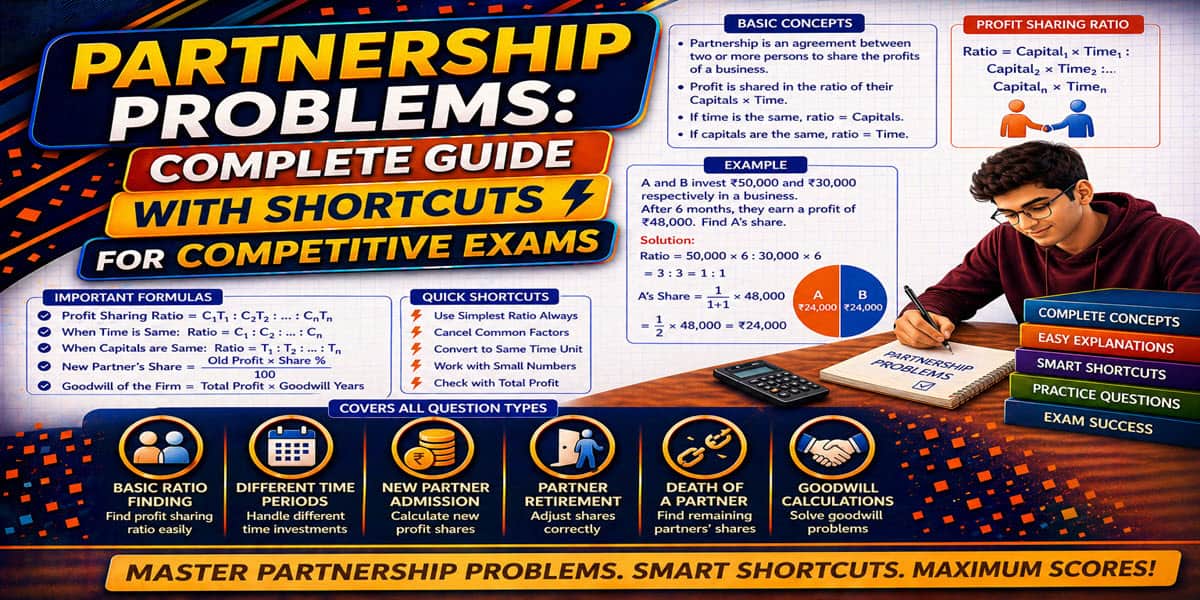
Partnership problems are ratio and proportion in a business context. Two or more people invest capital for a period of time, earn a combined profit, and then divide that profit in proportion to their investment. The formula is straightforward — but the variations in how investment and time are combined create a range of question types that catch unprepared candidates off guard.
This article builds on the ratio and proportion concepts from our Ratio and Proportion guide. Every partnership problem reduces to one key idea: profit is shared in the ratio of capital × time. Once you internalize this, every question type — simple partnership, compound partnership, sleeping partner, joining at different times — becomes a direct calculation.
In SSC CGL Tier 1, partnership contributes 1–2 questions. In Tier 2, 2–3 questions appear. In IBPS PO Prelims, 1–2 questions appear regularly. The questions are formula-driven and highly repetitive in pattern — making this a reliable full-marks topic with focused preparation.
Part 1: Core Concept — The Profit Sharing Rule
The Fundamental Formula
Profit share ∝ Capital × Time
For two partners A and B:
Profit of A : Profit of B = (Capital of A × Time of A) : (Capital of B × Time of B)
This single formula handles every partnership problem without exception.
Simple vs. Compound Partnership
Simple Partnership: All partners invest for the same duration.
Ratio = ratio of capitals only.
Compound Partnership: Partners invest for different durations.
Ratio = capital × time for each partner.
Part 2: Simple Partnership
All partners invest for the same time period — only capital differs.
Worked Example 1
A and B invest Rs. 30,000 and Rs. 50,000 respectively. Total profit = Rs. 24,000. Find each partner's share.
Ratio = 30,000 : 50,000 = 3 : 5
Total parts = 8
A's share = 3/8 × 24,000 = Rs. 9,000
B's share = 5/8 × 24,000 = Rs. 15,000
Worked Example 2 — Three Partners
A, B, C invest Rs. 20,000, Rs. 30,000, Rs. 50,000. Profit = Rs. 45,000. Find C's share.
Ratio = 20,000 : 30,000 : 50,000 = 2 : 3 : 5
Total parts = 10
C's share = 5/10 × 45,000 = Rs. 22,500
Worked Example 3 — Finding Investment
A and B share profit in ratio 3:4. B invested Rs. 56,000. Find A's investment.
A/B = 3/4
A = 3/4 × 56,000 = Rs. 42,000
Part 3: Compound Partnership
Partners invest for different time periods — ratio = capital × time.
Worked Example 4
A invests Rs. 40,000 for 8 months, B invests Rs. 60,000 for 6 months. Total profit = Rs. 33,000. Find each share.
A's equivalent = 40,000 × 8 = 3,20,000
B's equivalent = 60,000 × 6 = 3,60,000
Ratio = 3,20,000 : 3,60,000 = 8 : 9
Total parts = 17
A's share = 8/17 × 33,000 = Rs. 15,529
B's share = 9/17 × 33,000 = Rs. 17,471
Worked Example 5
A invests Rs. 50,000 for the full year. B joins after 4 months with Rs. 60,000. Profit = Rs. 38,000. Find B's share.
A's time = 12 months, B's time = 12 − 4 = 8 months
A's equivalent = 50,000 × 12 = 6,00,000
B's equivalent = 60,000 × 8 = 4,80,000
Ratio = 600 : 480 = 5 : 4
Total parts = 9
B's share = 4/9 × 38,000 = Rs. 16,889
Part 4: Partner Joins and Leaves — Mixed Duration
Worked Example 6
A starts business with Rs. 80,000. After 3 months B joins with Rs. 60,000. After 6 more months C joins with Rs. 1,20,000. Total profit at year end = Rs. 96,000. Find each share.
A's time = 12 months
B's time = 12 − 3 = 9 months
C's time = 12 − 9 = 3 months
A = 80,000 × 12 = 9,60,000
B = 60,000 × 9 = 5,40,000
C = 1,20,000 × 3 = 3,60,000
Ratio = 960 : 540 : 360 = 16 : 9 : 6
Total parts = 31
A's share = 16/31 × 96,000 = Rs. 49,548
B's share = 9/31 × 96,000 = Rs. 27,871
C's share = 6/31 × 96,000 = Rs. 18,581
Part 5: Sleeping Partner Problems
A sleeping partner invests capital but does not actively work in the business. The active partner may receive a salary or commission from profit before the remaining profit is divided.
Method
Step 1: Deduct active partner's salary/commission from total profit.
Step 2: Divide remaining profit in capital × time ratio.
Step 3: Add salary back to active partner's total share.
Worked Example 7
A and B invest Rs. 60,000 and Rs. 40,000. A manages the business and gets 20% of profit as salary. Remaining profit shared in investment ratio. Total profit = Rs. 25,000. Find each share.
A's salary = 20% of 25,000 = Rs. 5,000
Remaining profit = 25,000 − 5,000 = Rs. 20,000
Ratio = 60,000 : 40,000 = 3 : 2
A's share from remaining = 3/5 × 20,000 = Rs. 12,000
B's share from remaining = 2/5 × 20,000 = Rs. 8,000
A's total = 5,000 + 12,000 = Rs. 17,000
B's total = Rs. 8,000
Worked Example 8
A, B, C invest in ratio 3:4:5. A is the working partner and receives 15% of total profit as commission. Remaining distributed equally. Profit = Rs. 40,000. Find A's total share.
A's commission = 15% of 40,000 = Rs. 6,000
Remaining = 34,000
Wait — question says remaining distributed equally (not in ratio):
Each gets 34,000/3 = Rs. 11,333
A's total = 6,000 + 11,333 = Rs. 17,333
Note: Always read carefully — "in investment ratio" vs "equally" gives different answers.
Part 6: Finding When Equal Profit is Shared
Some problems ask: when does a partner join such that both partners receive equal profit?
Worked Example 9
A starts with Rs. 40,000. B joins later with Rs. 60,000. They share profit equally at year end. After how many months did B join?
For equal profit: Capital × Time must be equal.
A: 40,000 × 12 = 4,80,000
B: 60,000 × t = 4,80,000
t = 4,80,000/60,000 = 8 months
B invested for 8 months → B joined after 12 − 8 = 4 months
Part 7: Investment Changed During the Year
Some partners increase or decrease investment mid-year.
Worked Example 10
A invests Rs. 50,000 for the first 6 months, then increases to Rs. 70,000 for the remaining 6 months. B invests Rs. 80,000 throughout. Total profit = Rs. 57,000. Find A's share.
A's equivalent = (50,000 × 6) + (70,000 × 6)
= 3,00,000 + 4,20,000 = 7,20,000
B's equivalent = 80,000 × 12 = 9,60,000
Ratio = 720 : 960 = 3 : 4
Total parts = 7
A's share = 3/7 × 57,000 = Rs. 24,429
Part 8: Finding Total Profit from One Partner's Share
Worked Example 11
A and B invest Rs. 25,000 and Rs. 35,000. A's share of profit is Rs. 3,750. Find total profit.
Ratio = 25 : 35 = 5 : 7
A's fraction = 5/12
Total profit = 3,750 × 12/5 = Rs. 9,000
Worked Example 12
A, B, C invest in ratio 2:3:5. C's profit share is Rs. 8,000. Find B's share.
C's fraction = 5/10 = 1/2
Total profit = 8,000 × 2 = Rs. 16,000
B's share = 3/10 × 16,000 = Rs. 4,800
Part 9: Exam Traps and Speed Tips
Trap 1 — Time Units Must Be Consistent
If one partner's investment duration is in months and another's is in years — convert all to the same unit before multiplying.
A invests for 8 months, B for 1.5 years (= 18 months) — use months throughout.
Trap 2 — "Joins After" vs. "Invests For"
"B joins after 3 months" → B invests for 12 − 3 = 9 months (in a 12-month period)
"B invests for 3 months" → B invests for 3 months only
These give completely different ratios — read the question word carefully.
Trap 3 — Working Partner's Commission Base
Commission is always on total profit — not on remaining profit after commission.
If commission = 10% of profit and profit = Rs. 20,000:
Commission = 10% of 20,000 = Rs. 2,000 ✅
Not: 10% of (20,000 − commission) ❌
Trap 4 — Equal Profit ≠ Equal Investment
Equal profit sharing requires Capital × Time to be equal — not just capital. A partner with less capital can receive equal profit by investing for a longer time.
Speed Tip — Cancel Zeros First
When computing capital × time ratios, cancel common zeros immediately:
50,000 × 12 : 60,000 × 8 = 50 × 12 : 60 × 8 = 600 : 480 = 5 : 4
Working with smaller numbers reduces calculation errors significantly.
Quick Reference Formula Sheet
| Situation | Formula |
|---|---|
| Simple partnership ratio | Capital A : Capital B |
| Compound partnership ratio | (Cap A × Time A) : (Cap B × Time B) |
| Finding investment | Investment = ratio share × known investment / known ratio |
| Working partner total | Salary + share of remaining profit |
| Equal profit condition | Cap A × Time A = Cap B × Time B |
| Changed investment | Sum of (investment × time) for each period |
| Total from one share | Total = known share / known fraction |
Exam-Wise Strategy
| Exam | Questions | Common Types | Time Budget |
|---|---|---|---|
| SSC CGL Tier 1 | 1–2 | Simple + compound partnership | 60–75 sec each |
| SSC CGL Tier 2 | 2–3 | Sleeping partner + joining at different times | 90 sec each |
| IBPS PO Prelims | 1–2 | Compound + finding total profit | 60 sec each |
| IBPS PO Mains | 1–2 | Mixed duration + changed investment | 90 sec each |
| CAT | 1 | Complex multi-partner problems | 2 min |
2-Week Practice Plan
| Week | Focus | Daily Target |
|---|---|---|
| 1 | Simple + compound partnership + joining at different times | 15 questions, 20 min |
| 2 | Sleeping partner + changed investment + exam-style sets | 15 mixed questions, 20 min |