
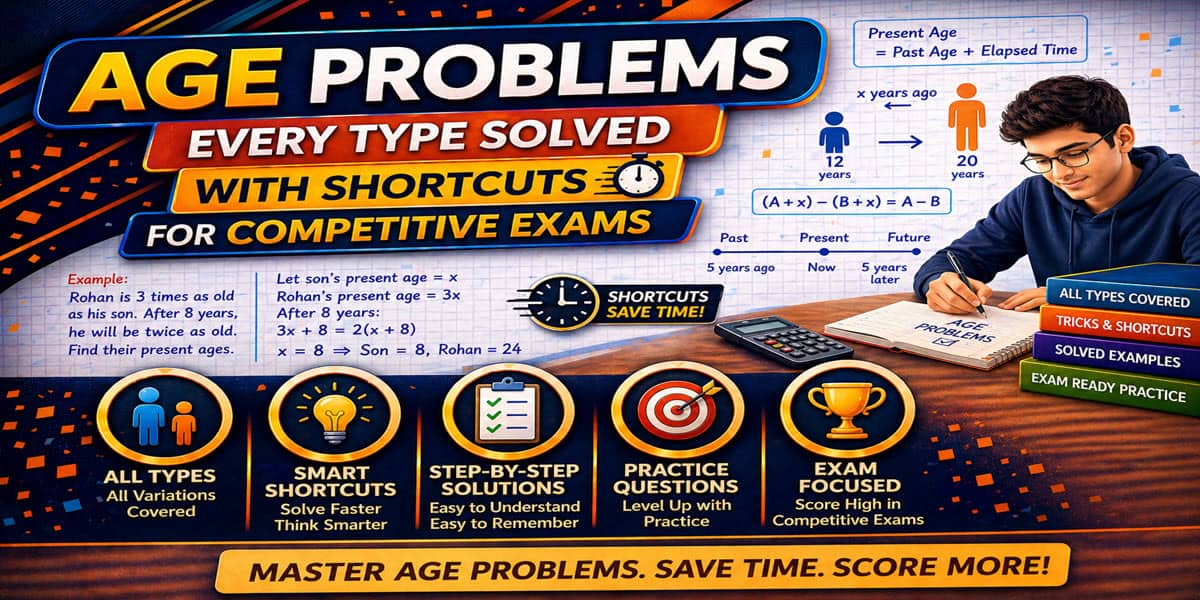
Age problems are among the most consistently tested topics across SSC CGL, IBPS PO, RRB NTPC, and SBI PO exams. Every question involves finding someone's current age, past age, or future age — given relationships between ages at different points in time. The math is simple arithmetic and algebra, but the word problems are often worded in ways that confuse the setup.
This article builds on algebraic equation skills from our Algebra Shortcuts guide. The entire strategy for age problems reduces to one habit: let the present age be x, translate every condition in the problem into an equation, solve, and verify. The shortcuts in this guide speed up both the setup and the solving steps.
In SSC CGL Tier 1, age problems contribute 2–3 questions. In IBPS PO Prelims, 1–2 questions appear. In RRB NTPC, 2–3 questions are standard. The questions are completely formula-free — pure logical translation into equations — making them full-marks territory with consistent practice.
Part 1: Core Framework — Setting Up Age Equations
The 3-Step Method
Step 1 — Define: Let present age of the unknown person = x
Step 2 — Translate: Convert every word condition into algebra:
- "n years ago" → subtract n from present age
- "n years later / after n years" → add n to present age
- "twice as old" → multiply by 2
- "ratio of ages" → set up ratio equation
Step 3 — Solve and Verify: Solve the equation, check answer satisfies all given conditions.
Key Translation Table
| Word Condition | Algebraic Expression |
|---|---|
| Present age of A | x |
| Age n years ago | x − n |
| Age n years later | x + n |
| A is twice B's age | A = 2B |
| A is k years older than B | A = B + k |
| Ratio of A to B is m:n | A/B = m/n |
| Sum of ages = S | A + B = S |
| Difference of ages = D | A − B = D (constant always) |
Critical property: The difference between two people's ages is always constant — regardless of past or future.
Part 2: Single Person Age Problems
Type 1 — Present and Future Age
Worked Example 1:
A person's age 5 years ago was 25. What will be his age 10 years from now?
Present age = 25 + 5 = 30
Age after 10 years = 30 + 10 = 40 years
Type 2 — Ratio of Present and Past Age
Worked Example 2:
The ratio of a person's present age to his age 10 years ago is 5:3. Find his present age.
Let present age = 5k, age 10 years ago = 3k
5k − 3k = 10
2k = 10 → k = 5
Present age = 5k = 25 years
Type 3 — Present and Future Ratio
Worked Example 3:
Present age of A is 24. After how many years will A's age be 3/2 times his present age?
3/2 × 24 = 36
Years needed = 36 − 24 = 12 years
Part 3: Two Person Age Problems
Type 1 — Sum and Difference Given
Worked Example 4:
Sum of ages of A and B is 50. A is 10 years older than B. Find their ages.
A + B = 50
A − B = 10
Adding: 2A = 60 → A = 30
B = 50 − 30 = 20
Ages: A = 30, B = 20
Type 2 — Present Ratio and Future Ratio
Worked Example 5:
Ratio of ages of A and B is 3:4. After 8 years ratio becomes 5:6. Find present ages.
Present: A = 3k, B = 4k
After 8 years: (3k+8)/(4k+8) = 5/6
6(3k+8) = 5(4k+8)
18k + 48 = 20k + 40
8 = 2k → k = 4
A = 12 years, B = 16 years
Verify: After 8 years → 20:24 = 5:6 ✓
Type 3 — Past Ratio and Present Condition
Worked Example 6:
5 years ago ratio of A's age to B's age was 2:3. A is now 25. Find B's present age.
5 years ago: A = 25−5 = 20
Ratio: 20/B₅ = 2/3 → B₅ = 30
B's present age = 30 + 5 = 35 years
Type 4 — Age Difference and Future Sum
Worked Example 7:
A is 5 years older than B. Sum of their ages after 3 years = 43. Find present ages.
Let B = x, A = x+5
After 3 years: (x+5+3) + (x+3) = 43
2x + 11 = 43 → 2x = 32 → x = 16
B = 16, A = 21
Part 4: Parent and Child Age Problems
These are among the most commonly tested patterns in SSC CGL and IBPS PO.
Type 1 — Father and Son Present Ages
Worked Example 8:
Father is 4 times as old as his son. After 20 years father will be twice as old as son. Find present ages.
Let son = x, father = 4x
After 20 years: 4x+20 = 2(x+20)
4x+20 = 2x+40
2x = 20 → x = 10
Son = 10 years, Father = 40 years
Verify: After 20 years → Son = 30, Father = 60 = 2 × 30 ✓
Type 2 — Mother, Father and Child
Worked Example 9:
Mother is 3 times as old as daughter. 12 years ago mother was 6 times as old as daughter. Find present ages.
Let daughter = x, mother = 3x
12 years ago: 3x−12 = 6(x−12)
3x−12 = 6x−72
60 = 3x → x = 20
Daughter = 20, Mother = 60
Verify: 12 years ago → Daughter = 8, Mother = 48 = 6 × 8 ✓
Type 3 — Age When Born
Worked Example 10:
A father is 30 years older than his son. After 5 years father will be 3 times as old as son. How old was father when son was born?
Let son's present age = x, father = x+30
After 5 years: x+30+5 = 3(x+5)
x+35 = 3x+15
20 = 2x → x = 10
Son = 10, Father = 40
Father's age when son was born = 40−10 = 30 years
Part 5: Three Person Age Problems
Worked Example 11
Sum of ages of A, B, C is 90. A is 5 years older than B. C is 3 years younger than B. Find their ages.
Let B = x, A = x+5, C = x−3
(x+5) + x + (x−3) = 90
3x + 2 = 90 → 3x = 88 → x = 29.33
Non-integer answer — re-read question. If exact, assume B = 29.33 is a problem error. For exam: use given options.
Worked Example 12:
Ages of A, B, C are in ratio 2:3:5. Sum = 70. Find C's age.
Total parts = 10
C = 5/10 × 70 = 35 years
Worked Example 13
Average age of A, B, C is 24. Average of A and B is 20. Find C's age.
Sum of A+B+C = 24 × 3 = 72
Sum of A+B = 20 × 2 = 40
C = 72 − 40 = 32 years
Part 6: Average Age Problems
Type 1 — New Member Joins
Worked Example 14:
Average age of 5 members is 30. A new member joins and average becomes 32. Find new member's age.
Original sum = 5 × 30 = 150
New sum = 6 × 32 = 192
New member's age = 192 − 150 = 42 years
Type 2 — Member Leaves
Worked Example 15:
Average age of 8 people is 25. One person of age 40 leaves. Find new average.
Original sum = 8 × 25 = 200
New sum = 200 − 40 = 160
New average = 160/7 = 22.86 years
Type 3 — Member Replaced
Worked Example 16:
Average age of 10 people is 28. One person of age 45 is replaced by a new person. Average becomes 27. Find new person's age.
Original sum = 280
New sum = 27 × 10 = 270
Sum decreased by 10 → New person = 45 − 10 = 35 years
Shortcut: Change in average × number of people = difference between old and new member's age.
(28−27) × 10 = 10 → New = 45−10 = 35 ✓
Part 7: Exam Shortcuts — Pattern Recognition
Shortcut 1 — Ratio Method for Two Ratio Problems
When present ratio and future/past ratio are both given:
Let ages = mk and nk (from present ratio m:n)
Set up one equation using second ratio condition.
Solve for k, multiply by m and n.
This is the fastest setup — avoids two-variable equations.
Shortcut 2 — Age Difference is Always Constant
If A is 10 years older than B now — A will always be 10 years older. Use this to reduce unknowns:
Instead of A = x, B = y — use B = x, A = x+10 (one variable only).
Shortcut 3 — Average Age Change
When one member is replaced:
Age of new member = Age of old member + (change in average × number of members)
Positive change → new member is older.
Negative change → new member is younger.
Shortcut 4 — Total Age Approach
For problems involving sum of ages — always compute total = average × count first. This single number unlocks most average age problems in one step.
Part 8: Exam Traps
Trap 1 — "n Years Hence" = "n Years Later"
"Hence" means "from now." So "5 years hence" = "5 years from now" = add 5 to present age. Some candidates subtract — wrong.
Trap 2 — "n Times as Old" vs. "n Times Older"
"Twice as old" → A = 2B
"Twice older than" → A = B + 2B = 3B (older by twice, not equals twice)
In Indian competitive exams, "twice as old" and "twice older" are used interchangeably to mean A = 2B. If confused — use options to verify.
Trap 3 — Negative Ages
If your answer gives a negative age — you have set up the equation incorrectly or made a sign error. Ages are always positive. Recheck the translation of "n years ago" conditions.
Trap 4 — Ratio vs. Fraction
"Ratio of A to B is 3:2" → A/B = 3/2 → A = 1.5B.
Do not write A:B = 2:3 (reversed). Always write the ratio in the same order as mentioned.
Quick Reference Formula Sheet
| Problem Type | Setup |
|---|---|
| Present age | Let age = x |
| n years ago | x − n |
| n years later | x + n |
| A is k older than B | A = B + k |
| A is m times B | A = mB |
| Sum given | A + B = S |
| Ratio given | A/B = m/n → A = mk, B = nk |
| Average age change | New member = Old member ± (Δavg × n) |
| Age when born | Parent age − Child age (constant) |
Exam-Wise Strategy
| Exam | Questions | Common Types | Time Budget |
|---|---|---|---|
| SSC CGL Tier 1 | 2–3 | Two-person ratio, parent-child | 60–75 sec each |
| SSC CGL Tier 2 | 2–3 | Three-person + average age | 75 sec each |
| IBPS PO Prelims | 1–2 | Ratio + future condition | 60 sec each |
| RRB NTPC | 2–3 | Simple ratio, sum-difference | 60 sec each |
| SBI PO | 1–2 | Multi-person + average | 75 sec each |
2-Week Practice Plan
| Week | Focus | Daily Target |
|---|---|---|
| 1 | Single + two-person problems — all types | 15 questions, 20 min |
| 2 | Parent-child + three-person + average age | 15 mixed questions, 20 min |