
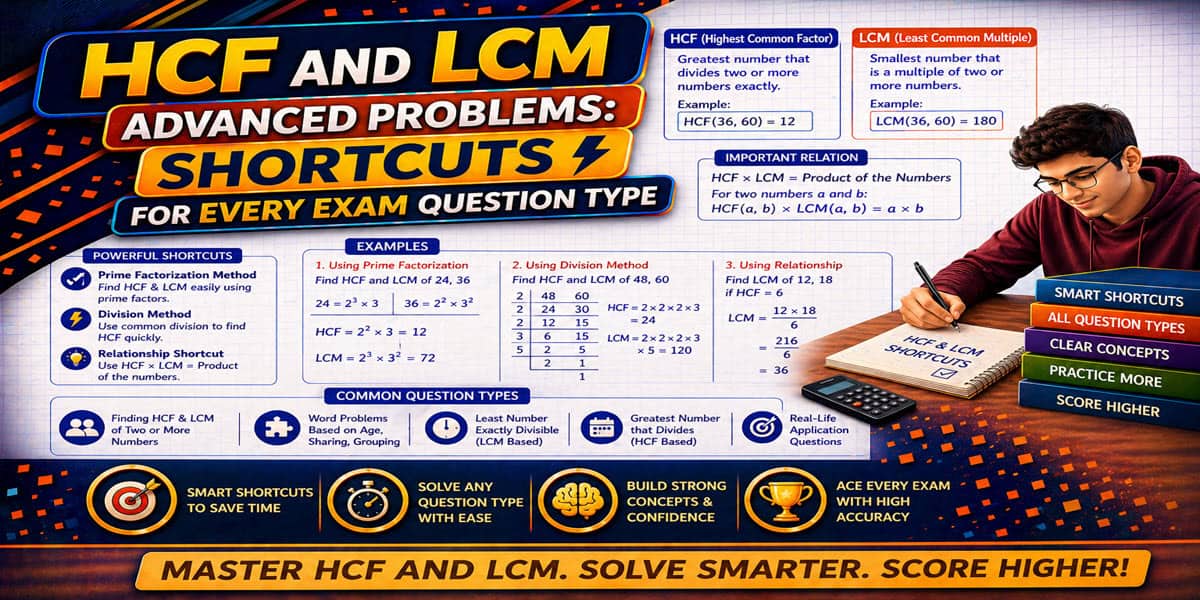
Basic HCF and LCM — finding the HCF and LCM of two or three numbers — is covered in our Number System Tricks guide. This article starts where that guide ends. Here, the focus is entirely on exam-level application: remainder problems, bell-ringing and meeting problems, tiling and arrangement problems, LCM of fractions, and the co-prime shortcut that saves 30 seconds per question.
Every pattern here appears in SSC CGL, IBPS PO, CAT, and RRB exams. The questions look different on the surface — trains meeting, bells ringing, tiles fitting, numbers leaving remainders — but each one reduces to a single HCF or LCM calculation once the pattern is identified. That pattern recognition is the entire skill this article builds.
In SSC CGL Tier 1, HCF/LCM contributes 2–3 questions. In Tier 2, 3–4 questions appear across different application types. In IBPS PO Prelims, 1–2 questions appear. In CAT, HCF/LCM appears within number system problems.
Part 1: Quick Recall — Core Formulas
Before diving into advanced problems, these two relationships are used constantly:
HCF × LCM = Product of two numbers
(Valid only for exactly two numbers)
HCF of fractions = HCF of numerators / LCM of denominators
LCM of fractions = LCM of numerators / HCF of denominators
Co-prime shortcut:
If HCF of two numbers = 1, they are co-prime.
LCM of co-prime numbers = their product.
Part 2: Remainder Problems — The Most Tested Pattern
Type 1 — Same Remainder from All Numbers
When a number N is divided by a, b, c and leaves the same remainder r each time:
N = LCM(a, b, c) × k + r for some integer k
Worked Example 1:
Find the smallest number that leaves remainder 3 when divided by 4, 6, and 9.
LCM(4, 6, 9) = 36
Smallest number = 36 + 3 = 39
Verify: 39 ÷ 4 = 9 remainder 3 ✓, 39 ÷ 6 = 6 remainder 3 ✓, 39 ÷ 9 = 4 remainder 3 ✓
Type 2 — Different Remainders, But Difference is Constant
When N divided by a, b, c leaves remainders r₁, r₂, r₃ where:
a − r₁ = b − r₂ = c − r₃ = d (constant)
Then: N = LCM(a, b, c) × k − d
Worked Example 2:
Find the smallest number that when divided by 5, 6, 7 leaves remainders 3, 4, 5 respectively.
Differences: 5−3 = 2, 6−4 = 2, 7−5 = 2 → constant difference = 2
LCM(5, 6, 7) = 210
Smallest number = 210 − 2 = 208
Verify: 208 ÷ 5 = 41 remainder 3 ✓, 208 ÷ 6 = 34 remainder 4 ✓, 208 ÷ 7 = 29 remainder 5 ✓
Type 3 — Find Largest Number Dividing With Same Remainder
N₁ and N₂ both leave remainder r when divided by a number D.
Then D divides (N₁ − N₂) exactly.
D = HCF of all pairwise differences
Worked Example 3:
Find the largest number that divides 247, 319, and 703 leaving the same remainder.
Differences:
319 − 247 = 72
703 − 319 = 384
703 − 247 = 456
HCF(72, 384, 456):
HCF(72, 384) = 24
HCF(24, 456) = 24
Largest number = 24
Verify: 247 = 24×10 + 7, 319 = 24×13 + 7, 703 = 24×29 + 7 → same remainder 7 ✓
Type 4 — Find Remainder When Specific Number Divides
Worked Example 4:
Find the largest 4-digit number divisible by 12, 15, and 18.
LCM(12, 15, 18) = 180
Largest 4-digit multiple of 180:
9999 ÷ 180 = 55.55 → 55 × 180 = 9900
Part 3: Bell-Ringing and Meeting Problems
These are direct LCM applications — the most straightforward advanced HCF/LCM question type.
Bell Problems
Rule: Bells ring together at start. They ring together again after LCM of their individual intervals.
Worked Example 5:
Three bells ring at intervals of 12, 15, and 20 minutes. They ring together at 8:00 AM. When do they next ring together?
LCM(12, 15, 20) = 60 minutes
Next together = 8:00 AM + 60 min = 9:00 AM
Worked Example 6:
Four bells ring at intervals of 6, 8, 12, and 18 minutes. They ring together at 10:00 AM. How many times do they ring together before 1:00 PM (3 hours = 180 minutes)?
LCM(6, 8, 12, 18) = 72 minutes
Number of times = 180 ÷ 72 = 2.5 → 2 times (at 71st and 144th minute)
Plus the initial ring at 10:00 AM = 3 times total (including start)
Circular Track — Meeting Problems
Rule: Two people/objects moving on a circular track meet after LCM of their individual lap times (if moving in same direction, use relative speed; if opposite, use sum of speeds).
Worked Example 7:
A and B run around a circular track. A completes a lap in 15 min, B in 20 min. Starting together, when do they first meet at the starting point?
LCM(15, 20) = 60 minutes → 60 minutes
Worked Example 8:
A, B, C start together. A takes 10 min/lap, B takes 15 min/lap, C takes 6 min/lap. After how many minutes are all three at starting point together?
LCM(10, 15, 6) = 30 minutes → 30 minutes
Part 4: Tiling and Arrangement Problems
These use HCF — finding the largest unit that fits evenly into given dimensions.
Square Tile Problems
Rule: Largest square tile that fits a rectangular floor without cutting = HCF of length and breadth.
Worked Example 9:
A room is 16.5m × 11m. Find the largest square tile size and number of tiles needed.
Convert to cm: 1650cm × 1100cm
HCF(1650, 1100):
1650 = 1 × 1100 + 550
1100 = 2 × 550 + 0
HCF = 550cm = 5.5m
Number of tiles = (1650/550) × (1100/550) = 3 × 2 = 6 tiles
Grouping Problems
Rule: Largest equal group size from multiple sets = HCF.
Worked Example 10:
96 boys and 72 girls are to be divided into groups of equal size, each group having only boys or only girls. Find the largest group size and total groups.
HCF(96, 72) = 24
Largest group size = 24
Total groups = 96/24 + 72/24 = 4 + 3 = 7 groups
Part 5: LCM and HCF of Fractions
Formulas
HCF of fractions = HCF of numerators / LCM of denominators
LCM of fractions = LCM of numerators / HCF of denominators
Worked Example 11:
Find HCF and LCM of 2/3, 4/9, 8/27.
HCF of numerators (2, 4, 8) = 2
LCM of denominators (3, 9, 27) = 27
HCF = 2/27
LCM of numerators (2, 4, 8) = 8
HCF of denominators (3, 9, 27) = 3
LCM = 8/3
Verify: HCF divides all fractions, LCM is divisible by all fractions.
2/27 ÷ 2/3 = 2/27 × 3/2 = 1/9 ✓ (integer result means it divides evenly)
Part 6: HCF from Given LCM and Product
Worked Example 12:
LCM of two numbers is 180, their product is 2160. Find HCF.
HCF = Product / LCM = 2160 / 180 = 12
Worked Example 13:
HCF of two numbers is 14, LCM is 168. One number is 56. Find the other.
Product = HCF × LCM = 14 × 168 = 2352
Other number = 2352 / 56 = 42
Part 7: Co-prime Shortcut Problems
Two numbers are co-prime when HCF = 1. In competitive exams, this property is used to simplify problems significantly.
Co-prime Property in Fraction Reduction
A fraction a/b is in its simplest form when a and b are co-prime (HCF = 1).
Co-prime and LCM
LCM of co-prime numbers = their product.
Worked Example 14:
Two co-prime numbers have sum 45 and LCM 506. Find the numbers.
Since they are co-prime: LCM = product
Let numbers be a and b: a + b = 45, a × b = 506
Solve: a and b are roots of x² − 45x + 506 = 0
x = (45 ± √(2025−2024)) / 2 = (45 ± 1) / 2
x = 23 or x = 22
Numbers are 22 and 23 (consecutive → always co-prime ✓)
Part 8: Number of Integers Divisible by Given Numbers
Worked Example 15:
How many integers from 1 to 500 are divisible by both 6 and 8?
LCM(6, 8) = 24
Count = ⌊500/24⌋ = 20 numbers
Worked Example 16:
How many integers from 1 to 1000 are divisible by 4 or 6?
Divisible by 4: ⌊1000/4⌋ = 250
Divisible by 6: ⌊1000/6⌋ = 166
Divisible by both (LCM = 12): ⌊1000/12⌋ = 83
By inclusion-exclusion: 250 + 166 − 83 = 333
Part 9: Smallest Number with Specific Divisibility
Worked Example 17:
Find the smallest number that is exactly divisible by 12, 15, 18, and 27.
LCM(12, 15, 18, 27):
12 = 2² × 3
15 = 3 × 5
18 = 2 × 3²
27 = 3³
LCM = 2² × 3³ × 5 = 4 × 27 × 5 = 540
Worked Example 18:
Find the smallest number which when increased by 7 is divisible by 12, 16, and 24.
LCM(12, 16, 24) = 48
Number + 7 = 48 → Number = 41
Part 10: Exam Traps and Speed Tips
Trap 1 — HCF × LCM = Product of Two Numbers ONLY
This formula works for exactly two numbers. For three or more numbers:
HCF × LCM ≠ product of all numbers.
For three numbers a, b, c:
Use: a × b × c = HCF(a,b,c) × LCM(a,b,c) × LCM(a,b)/HCF(a,b) — this is complex.
Simpler: just compute HCF and LCM directly using prime factorization.
Trap 2 — LCM of Fractions Formula Direction
HCF of fractions → HCF on top, LCM on bottom
LCM of fractions → LCM on top, HCF on bottom
These are opposite to what intuition suggests — memorize the formula exactly.
Trap 3 — Meeting Problems With Different Start Points
Bell/meeting problems assume all start at the same time and place. If start times differ, adjust by subtracting the time difference before applying LCM.
Speed Tip — Euclidean Algorithm for HCF
For large numbers, use repeated division:
HCF(546, 364):
546 = 1 × 364 + 182
364 = 2 × 182 + 0
HCF = 182
This is faster than prime factorization for large numbers.
Quick Reference Formula Sheet
| Problem Type | Formula/Method |
|---|---|
| Same remainder from all divisors | LCM + remainder |
| Constant difference in remainders | LCM − difference |
| Largest divisor giving same remainder | HCF of pairwise differences |
| Bells ringing together | LCM of intervals |
| Largest square tile | HCF of dimensions |
| Equal grouping | HCF of quantities |
| HCF of fractions | HCF(numerators)/LCM(denominators) |
| LCM of fractions | LCM(numerators)/HCF(denominators) |
| HCF from LCM + product | HCF = Product/LCM |
| Co-prime LCM | LCM = product |
| Count divisible by both | ⌊N/LCM⌋ |
| Count divisible by either | ⌊N/a⌋ + ⌊N/b⌋ − ⌊N/LCM⌋ |
Exam-Wise Strategy
| Exam | Questions | Common Types | Time Budget |
|---|---|---|---|
| SSC CGL Tier 1 | 2–3 | Remainder type 1, bells, tiling | 60–75 sec each |
| SSC CGL Tier 2 | 3–4 | All types including fractions | 90 sec each |
| IBPS PO Prelims | 1–2 | Remainder, grouping, LCM meeting | 60 sec each |
| CAT | 1–2 | Co-prime, remainder, count problems | 90 sec each |
| RRB NTPC | 1–2 | Basic remainder, bells | 60 sec each |
2-Week Practice Plan
| Week | Focus | Daily Target |
|---|---|---|
| 1 | Remainder types 1–3 + bell problems + tiling | 15 questions, 20 min |
| 2 | Fractions + co-prime + count problems + exam sets | 15 mixed questions, 20 min |