
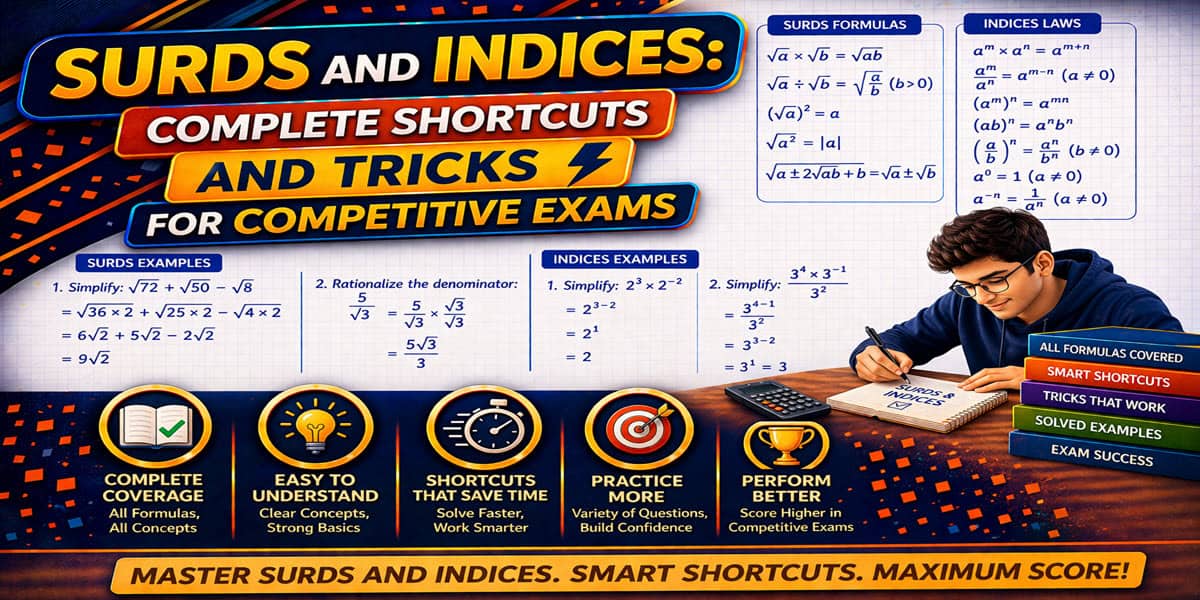
Surds and indices is one of those topics where a small number of rules — fully understood — unlock every question in the chapter. There are exactly 7 laws of indices. There are exactly 3 types of surd problems. Master these, and surds and indices becomes one of the fastest-scoring topics in any competitive exam.
The confusion most candidates face comes from mixing up the rules, especially when negative exponents, fractional exponents, or nested surds appear. This guide eliminates that confusion by building each rule from scratch with clear logic, then applying it to every exam question type systematically.
In SSC CGL Tier 1, surds and indices contributes 2–3 questions. In Tier 2, 3–4 questions appear. In CAT, indices problems appear within algebra and number system sets. In IBPS PO, 1–2 questions appear in Prelims. Across all exams, these questions are among the fastest to solve once the rules are memorized.
Part 1: Laws of Indices — The Complete Set
What Is an Index (Exponent)?
In aⁿ — a is the base, n is the index (or exponent or power).
aⁿ means a multiplied by itself n times.
The 7 Laws of Indices
Law 1 — Multiplication (Same Base):
aᵐ × aⁿ = aᵐ⁺ⁿ
Law 2 — Division (Same Base):
aᵐ ÷ aⁿ = aᵐ⁻ⁿ
Law 3 — Power of a Power:
(aᵐ)ⁿ = aᵐˣⁿ
Law 4 — Power of a Product:
(ab)ⁿ = aⁿ × bⁿ
Law 5 — Power of a Fraction:
(a/b)ⁿ = aⁿ/bⁿ
Law 6 — Zero Exponent:
a⁰ = 1 (for any a ≠ 0)
Law 7 — Negative Exponent:
a⁻ⁿ = 1/aⁿ
Fractional Exponent (Surd Connection)
a^(1/n) = ⁿ√a (nth root of a)
a^(m/n) = ⁿ√(aᵐ) = (ⁿ√a)ᵐ
Part 2: Worked Examples — Laws of Indices
Basic Law Application
Worked Example 1:
Simplify: 2³ × 2⁵
= 2³⁺⁵ = 2⁸ = 256
Worked Example 2:
Simplify: 5⁷ ÷ 5⁴
= 5⁷⁻⁴ = 5³ = 125
Worked Example 3:
Simplify: (3²)⁴
= 3²ˣ⁴ = 3⁸ = 6561
Worked Example 4:
Simplify: (2 × 3)³
= 2³ × 3³ = 8 × 27 = 216
Negative and Zero Exponents
Worked Example 5:
Simplify: 5⁰ + 3⁻² + 2⁻¹
= 1 + 1/9 + 1/2
= 18/18 + 2/18 + 9/18 = 29/18
Worked Example 6:
Find value: (2/3)⁻³
= (3/2)³ = 27/8 = 3.375
Rule: (a/b)⁻ⁿ = (b/a)ⁿ — flip the fraction, remove the negative sign.
Fractional Exponents
Worked Example 7:
Simplify: 27^(2/3)
= (27^(1/3))² = (³√27)² = 3² = 9
Worked Example 8:
Simplify: 16^(3/4)
= (16^(1/4))³ = (⁴√16)³ = 2³ = 8
Worked Example 9:
Simplify: (32)^(−3/5)
= 1/(32^(3/5)) = 1/((⁵√32)³) = 1/2³ = 1/8
Part 3: Indices Problems — Exam Patterns
Pattern 1 — Same Base, Find Exponent
Worked Example 10:
If 2ˣ = 64, find x.
64 = 2⁶ → 2ˣ = 2⁶ → x = 6
Worked Example 11:
If 3ˣ⁺² = 243, find x.
243 = 3⁵ → 3ˣ⁺² = 3⁵ → x+2 = 5 → x = 3
Pattern 2 — Different Bases, Make Equal
Worked Example 12:
If 4ˣ = 8ʸ, find x:y.
4ˣ = (2²)ˣ = 2²ˣ
8ʸ = (2³)ʸ = 2³ʸ
2²ˣ = 2³ʸ → 2x = 3y → x/y = 3/2 → x:y = 3:2
Pattern 3 — Mixed Bases Combined
Worked Example 13:
Simplify: (xᵃ/xᵇ)^(a+b) × (xᵇ/xᶜ)^(b+c) × (xᶜ/xᵃ)^(c+a)
= x^((a−b)(a+b)) × x^((b−c)(b+c)) × x^((c−a)(c+a))
= x^(a²−b²) × x^(b²−c²) × x^(c²−a²)
= x^(a²−b²+b²−c²+c²−a²)
= x⁰ = 1
This pattern — three cyclic fractions multiplied — always equals 1. Recognize it instantly.
Pattern 4 — Finding Value of Expression
Worked Example 14:
If x = 3 + 2√2, find x + 1/x.
1/x = 1/(3+2√2) = (3−2√2)/((3+2√2)(3−2√2)) = (3−2√2)/(9−8) = 3−2√2
x + 1/x = (3+2√2) + (3−2√2) = 6
Part 4: What Is a Surd?
A surd is an irrational root that cannot be simplified to a rational number.
√4 = 2 → not a surd (rational result)
√2 = 1.414... → surd (irrational, cannot be simplified)
³√8 = 2 → not a surd
³√5 → surd
Types of Surds
Pure Surd: Only an irrational root — no rational part. Example: √3, ⁵√7
Mixed Surd: Rational number × irrational root. Example: 2√3, 5√7
Compound Surd: Sum or difference of surds. Example: √2 + √3, 3 + √5
Like Surds: Surds with same irrational part. Example: 2√3 and 5√3 (both have √3)
Unlike Surds: Different irrational parts. Example: 2√3 and 5√2
Part 5: Surd Operations
Addition and Subtraction — Like Surds Only
Worked Example 15:
Simplify: 3√5 + 7√5 − 2√5
= (3+7−2)√5 = 8√5
Worked Example 16:
Simplify: √12 + √27 − √48
First simplify each:
√12 = √(4×3) = 2√3
√27 = √(9×3) = 3√3
√48 = √(16×3) = 4√3
= 2√3 + 3√3 − 4√3 = √3
Multiplication of Surds
Worked Example 17:
Simplify: √6 × √10
= √(6×10) = √60 = √(4×15) = 2√15
Worked Example 18:
Simplify: (2√3) × (3√5)
= (2×3) × √(3×5) = 6√15
Simplifying Surds — Remove Perfect Square Factors
Worked Example 19:
Simplify: √180
180 = 36 × 5
√180 = √36 × √5 = 6√5
Worked Example 20:
Simplify: ³√54
54 = 27 × 2
³√54 = ³√27 × ³√2 = 3³√2
Part 6: Rationalisation of Surds
Rationalisation means removing the surd from the denominator of a fraction.
Type 1 — Single Surd in Denominator
Multiply numerator and denominator by the surd.
Worked Example 21:
Rationalise: 6/√3
= 6/√3 × √3/√3 = 6√3/3 = 2√3
Worked Example 22:
Rationalise: 10/(3√5)
= 10/(3√5) × √5/√5 = 10√5/15 = 2√5/3
Type 2 — Binomial Surd in Denominator (Conjugate Method)
Multiply numerator and denominator by the conjugate.
Conjugate of (a + √b) = (a − √b)
Conjugate of (√a + √b) = (√a − √b)
Key identity: (a+b)(a−b) = a² − b²
Worked Example 23:
Rationalise: 1/(3+√2)
Conjugate = (3−√2)
= (3−√2)/((3+√2)(3−√2))
= (3−√2)/(9−2)
= (3−√2)/7
Worked Example 24:
Rationalise: (√5+√3)/(√5−√3)
= (√5+√3)² / ((√5−√3)(√5+√3))
= (5 + 2√15 + 3) / (5−3)
= (8 + 2√15) / 2
= 4 + √15
Part 7: Comparison of Surds
SSC CGL frequently asks which of two or more surds is larger.
Method — Make the Index Same
Worked Example 25:
Which is greater: ²√3 or ³√4?
Make indices equal — LCM of 2 and 3 = 6
²√3 = 3^(1/2) = 3^(3/6) = ⁶√(3³) = ⁶√27
³√4 = 4^(1/3) = 4^(2/6) = ⁶√(4²) = ⁶√16
⁶√27 > ⁶√16 → ²√3 > ³√4
Worked Example 26:
Arrange in ascending order: ²√3, ³√4, ⁶√17
LCM of 2, 3, 6 = 6
²√3 = ⁶√27
³√4 = ⁶√16
⁶√17 = ⁶√17
Ascending order: ⁶√16 < ⁶√17 < ⁶√27
∴ ³√4 < ⁶√17 < ²√3
Part 8: Special Identities Involving Surds
Identity 1 — Square of a Binomial Surd
(√a + √b)² = a + 2√(ab) + b
Worked Example 27:
(√3 + √5)²
= 3 + 2√15 + 5 = 8 + 2√15
Identity 2 — Product of Conjugate Surds
(√a + √b)(√a − √b) = a − b
Worked Example 28:
(√7 + √3)(√7 − √3)
= 7 − 3 = 4
Identity 3 — Finding √(a ± 2√b) Form
If √(a + 2√b) = √x + √y, then x + y = a and xy = b.
Worked Example 29:
Simplify: √(7 + 2√12)
Find x and y: x+y = 7, xy = 12 → x=4, y=3
√(7 + 2√12) = √4 + √3 = 2 + √3
Part 9: Exam Traps and Speed Tips
Trap 1 — Adding Unlike Surds
√2 + √3 ≠ √5. Unlike surds cannot be added — they must stay as √2 + √3.
Trap 2 — (a+b)² ≠ a² + b²
(√2 + √3)² = 2 + 2√6 + 3 = 5 + 2√6 ≠ √4 + √9 = 5
Always expand using (a+b)² = a² + 2ab + b².
Trap 3 — Negative Base with Even Exponent
(−2)⁴ = +16, not −16. Even exponent always gives positive result regardless of base sign.
(−2)³ = −8. Odd exponent preserves the sign.
Trap 4 — Fractional Exponent Direction
a^(m/n) = (ⁿ√a)ᵐ — take root first, then raise to power. This avoids large intermediate numbers.
27^(2/3): Take cube root first → 3, then square → 9. ✓
Squaring first → 729, then cube root → 9. Same answer but larger calculation.
Speed Tip — Surd Comparison
When comparing surds of different orders — always convert to a common root using LCM. This is the only reliable method and takes under 30 seconds for any pair.
Quick Reference Formula Sheet
| Law | Formula |
|---|---|
| Multiplication | aᵐ × aⁿ = aᵐ⁺ⁿ |
| Division | aᵐ ÷ aⁿ = aᵐ⁻ⁿ |
| Power of power | (aᵐ)ⁿ = aᵐⁿ |
| Zero exponent | a⁰ = 1 |
| Negative exponent | a⁻ⁿ = 1/aⁿ |
| Fractional exponent | a^(m/n) = (ⁿ√a)ᵐ |
| Negative fraction flip | (a/b)⁻ⁿ = (b/a)ⁿ |
| Rationalise single surd | Multiply by √a/√a |
| Rationalise binomial | Multiply by conjugate |
| Conjugate product | (√a+√b)(√a−√b) = a−b |
| Surd comparison | Convert to same index using LCM |
Exam-Wise Strategy
| Exam | Questions | Common Types | Time Budget |
|---|---|---|---|
| SSC CGL Tier 1 | 2–3 | Laws of indices, surd simplification | 60–75 sec each |
| SSC CGL Tier 2 | 3–4 | Rationalisation, comparison, expressions | 90 sec each |
| CAT | 1–2 | Indices with variables, nested surds | 2 min each |
| IBPS PO Prelims | 1–2 | Basic indices, surd simplification | 60 sec each |
2-Week Practice Plan
| Week | Focus | Daily Target |
|---|---|---|
| 1 | All 7 laws of indices + fractional/negative exponents | 15 questions, 20 min |
| 2 | Surd simplification + rationalisation + comparison | 15 mixed questions, 20 min |