
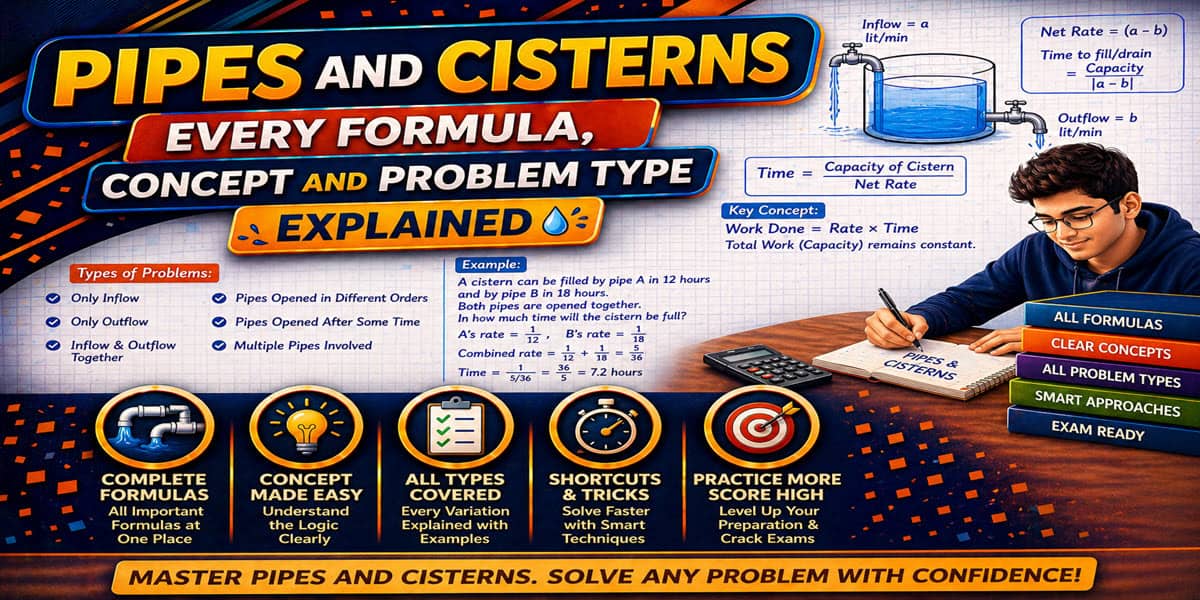
Pipes and cisterns is one of the most predictable topics in competitive exam mathematics. Every question — regardless of how it is worded — comes back to one idea: how fast is a tank being filled or emptied, and how long does it take when multiple pipes work together?
The connection to Time and Work is direct and intentional. If you have already mastered Time and Work (see our Time and Work guide), pipes and cisterns will take you less than an hour to fully understand. A pipe filling a tank is identical in structure to a worker completing a job — the formulas are the same, only the language changes.
In SSC CGL Tier 1, pipes and cisterns contributes 1–2 questions. In Tier 2, this increases to 2–3 questions. In IBPS PO Prelims and RRB NTPC, 1–2 questions appear regularly. The questions are formula-driven and highly repetitive in pattern — making this one of the highest-accuracy topics once the core formulas are internalized.
Part 1: Core Concept — The Work Framework
Tank as a Unit of Work
Think of filling the entire tank as completing 1 unit of work.
- A pipe that fills the tank in n hours completes 1/n work per hour
- A pipe that empties the tank in n hours removes 1/n work per hour
- Filling pipes are positive (add to work done)
- Emptying pipes (outlets) are negative (subtract from work done)
The Master Formula
Combined rate = Sum of all individual rates
Time to complete = 1 / Combined rate
This single framework handles every pipes and cisterns problem without exception.
Part 2: Single Pipe Problems
Type 1 — Basic Fill Time
Worked Example 1:
Pipe A fills a tank in 6 hours. How much of the tank is filled in 4 hours?
Rate of A = 1/6 per hour
Work done in 4 hours = 4 × 1/6 = 2/3 of the tank
Type 2 — Finding Time to Fill
Worked Example 2:
A pipe fills 1/4 of a tank in 3 hours. How long to fill the complete tank?
Rate = (1/4) / 3 = 1/12 per hour
Time to fill = 12 hours
Part 3: Two Pipes Working Together
Both Filling
Formula:
Time = (A × B) / (A + B)
Where A and B are individual fill times.
Worked Example 3:
Pipe A fills a tank in 12 hours, Pipe B in 8 hours. Both open together — time to fill?
Time = (12 × 8) / (12 + 8) = 96 / 20 = 4.8 hours
Fraction method (more flexible):
Combined rate = 1/12 + 1/8 = 2/24 + 3/24 = 5/24
Time = 24/5 = 4.8 hours ✓
One Filling, One Emptying
Formula:
Net rate = Fill rate − Empty rate
Worked Example 4:
Pipe A fills a tank in 10 hours. Pipe B empties it in 15 hours. Both open together — time to fill?
Net rate = 1/10 − 1/15 = 3/30 − 2/30 = 1/30
Time = 30 hours
Important check: If empty rate > fill rate → tank never fills. Always verify net rate is positive.
Worked Example 5:
Pipe A fills in 6 hours, Pipe B empties in 4 hours. Both open — what happens?
Net rate = 1/6 − 1/4 = 2/12 − 3/12 = −1/12
Net rate is negative → tank empties, never fills.
Part 4: Three Pipes Working Together
Worked Example 6:
Pipes A, B, C fill a tank in 6, 8, and 12 hours respectively. All three open together — time to fill?
Combined rate = 1/6 + 1/8 + 1/12
LCM of 6, 8, 12 = 24
= 4/24 + 3/24 + 2/24 = 9/24 = 3/8
Time = 8/3 = 2 hours 40 minutes
Worked Example 7:
Pipes A and B fill a tank in 10 and 15 hours. Pipe C empties in 20 hours. All three open — time to fill?
Net rate = 1/10 + 1/15 − 1/20
LCM = 60
= 6/60 + 4/60 − 3/60 = 7/60
Time = 60/7 ≈ 8.57 hours
Part 5: Pipe Opened and Closed After Partial Fill
This is the most frequently tested problem type in SSC CGL and IBPS PO. One pipe fills for a fixed time, then another joins — or one pipe is closed after partial fill.
Type A — Second Pipe Opens After Some Time
Worked Example 8:
Pipe A fills a tank in 12 hours. After 4 hours, Pipe B (fills in 8 hours) is also opened. Total time to fill?
Work done by A in 4 hours = 4 × 1/12 = 1/3
Remaining work = 1 − 1/3 = 2/3
Combined rate (A + B) = 1/12 + 1/8 = 2/24 + 3/24 = 5/24
Time for remaining work = (2/3) / (5/24) = (2/3) × (24/5) = 48/15 = 3.2 hours
Total time = 4 + 3.2 = 7.2 hours
Type B — One Pipe Closed Before Tank is Full
Worked Example 9:
Pipes A and B fill a tank together in 6 hours. Pipe A alone fills in 10 hours. If A is closed after 4 hours, how long does B take to finish?
Combined rate = 1/6, Rate of A = 1/10
Rate of B = 1/6 − 1/10 = 5/30 − 3/30 = 2/30 = 1/15
Work done by both in 4 hours = 4 × 1/6 = 2/3
Remaining = 1/3
Time for B alone = (1/3) / (1/15) = (1/3) × 15 = 5 hours
Part 6: Tank Partially Filled — Find Pipe Rate or Time
Worked Example 10:
A tank is 2/3 full. Pipe A fills it in 9 hours (full tank). Pipe B empties it in 6 hours. If both open, when does the tank empty completely?
Net rate = 1/9 − 1/6 = 2/18 − 3/18 = −1/18
Negative net rate → tank is emptying at 1/18 per hour
Current fill = 2/3
Time to empty = (2/3) / (1/18) = (2/3) × 18 = 12 hours
Part 7: Leak Problems
A leak in the tank acts as an outlet pipe — it empties at some rate. Leak problems always give two pieces of information: fill time with no leak, and fill time with the leak active.
The Leak Formula
Leak rate = (1/Normal fill time) − (1/Fill time with leak)
Worked Example 11:
A pipe fills a tank in 20 hours. Due to a leak, it takes 30 hours to fill. How long will the leak take to empty the full tank?
Leak rate = 1/20 − 1/30 = 3/60 − 2/60 = 1/60
Leak empties full tank in 60 hours
Worked Example 12:
A pipe fills a tank in 15 hours. A leak at the bottom empties it in 20 hours. How long to fill the tank with both pipe and leak active?
Net rate = 1/15 − 1/20 = 4/60 − 3/60 = 1/60
Time = 60 hours
Part 8: Efficiency-Based Problems
Some problems give the capacity of the tank directly (in litres) and pipe rates in litres per hour instead of fraction of tank per hour. The approach is identical — just work with actual numbers.
Worked Example 13:
A tank holds 1,200 litres. Pipe A fills at 60 litres/hour, Pipe B fills at 40 litres/hour, Pipe C empties at 30 litres/hour. All three open — time to fill?
Net rate = 60 + 40 − 30 = 70 litres/hour
Time = 1200 / 70 = 17.14 hours ≈ 17 hours 8 minutes
Part 9: Alternate Opening — Pipes Open in Turns
A special SSC CGL pattern: pipes open alternately, not simultaneously.
Worked Example 14:
Pipe A fills a tank in 4 hours, Pipe B in 6 hours. They open alternately — A for the 1st hour, B for the 2nd hour, A for the 3rd, and so on. How long to fill?
Work in 1st hour (A) = 1/4
Work in 2nd hour (B) = 1/6
Work in 2 hours = 1/4 + 1/6 = 3/12 + 2/12 = 5/12
Work in 4 hours (2 cycles) = 10/12 = 5/6
Remaining after 4 hours = 1 − 5/6 = 1/6
5th hour is A's turn: A fills 1/4 per hour
Time for A to fill 1/6: (1/6) / (1/4) = 4/6 = 2/3 hour
Total = 4 + 2/3 = 4 hours 40 minutes
Part 10: Exam Traps and Speed Tips
Trap 1 — Outlet Rate Greater Than Inlet Rate
Always compute net rate before setting up the equation. If net rate is negative, the tank empties — no fill time exists. Many candidates set up an equation and get a negative answer, then panic. The correct interpretation: tank cannot be filled with these pipes open simultaneously.
Trap 2 — "Together" vs. "Alternately"
"Both pipes open together" = add rates simultaneously.
"Pipes open alternately" = calculate work per cycle, then find remaining.
These two setups give completely different answers for the same pipes — read the question word carefully.
Trap 3 — Time vs. Rate Confusion
Never add times directly. You can only add rates (work per hour).
❌ Wrong: Two pipes fill in 6 and 4 hours → together = (6+4)/2 = 5 hours
✅ Correct: Rates = 1/6 + 1/4 = 5/12 → Time = 12/5 = 2.4 hours
Trap 4 — Leak Problems with "Takes Longer"
When a leak is introduced, the fill time increases. Leak rate = (faster rate) − (slower rate). Never add the rates when one is a leak.
Speed Tip — LCM Method
For problems with multiple pipes, take LCM of all times as the total tank capacity. Then express each rate in units per hour. This eliminates fractions entirely.
Worked Example 15 — LCM Method:
Pipes A, B, C fill in 4, 6, 12 hours. All open together.
LCM (4,6,12) = 12 → Tank capacity = 12 units
A fills 12/4 = 3 units/hour
B fills 12/6 = 2 units/hour
C fills 12/12 = 1 unit/hour
Combined = 6 units/hour
Time = 12/6 = 2 hours
No fractions, no LCM of fractions — just whole number arithmetic.
Quick Reference Formula Sheet
| Situation | Formula |
|---|---|
| Single pipe fill time | Time = 1 / Rate |
| Two pipes filling | Time = (A × B) / (A + B) |
| One fill, one empty | Net rate = 1/A − 1/B |
| Three pipes | Net rate = 1/A + 1/B − 1/C |
| Partial fill remaining | Remaining = 1 − Work done |
| Leak rate | 1/Normal − 1/With leak |
| Efficiency (litres) | Time = Capacity / Net rate |
| Alternate pipes (2hr cycle) | Work = Rate A + Rate B per cycle |
Exam-Wise Strategy
| Exam | Questions | Common Types | Time Budget |
|---|---|---|---|
| SSC CGL Tier 1 | 1–2 | Two pipes, leak problems | 60–75 sec each |
| SSC CGL Tier 2 | 2–3 | Partial fill, alternate opening | 90 sec each |
| IBPS PO Prelims | 1–2 | Two/three pipes combined | 60 sec each |
| IBPS PO Mains | 1–2 | Leak + efficiency problems | 90 sec each |
| RRB NTPC | 1–2 | Basic fill/empty, two pipes | 60 sec each |
2-Week Practice Plan
| Week | Focus | Daily Target |
|---|---|---|
| 1 | Single pipe + two pipes together + leak problems | 15 questions, 20 min |
| 2 | Partial fill + alternate opening + LCM method | 15 mixed questions, 20 min |