
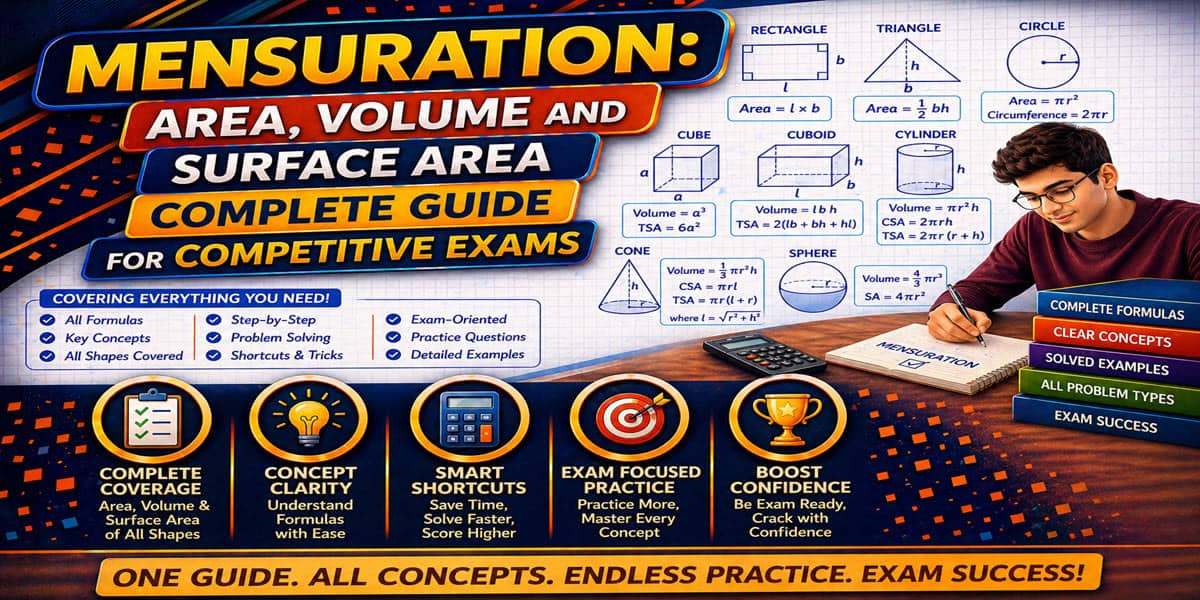
Mensuration is the branch of mathematics that deals with measurement — length, area, volume, and surface area of geometric shapes. Every construction project, every packaging design, every land measurement, and every engineering calculation uses mensuration. In competitive exams, mensuration is one of the highest-weightage topics in SSC CGL Tier 2 and appears consistently across all major exams.
The challenge with mensuration is not the complexity of individual formulas — most are straightforward. The challenge is the sheer number of shapes and the fact that exam questions often combine two shapes, change dimensions, or ask for one measurement given another. This guide organizes every formula clearly, shows the pattern behind each, and gives worked examples for every question type that appears in SSC CGL, IBPS PO, and CAT.
Note: For pure geometry concepts — angle properties, triangle theorems, circle theorems — refer to our Geometry Shortcuts guide. This article focuses exclusively on measurement: area, perimeter, volume, and surface area calculations.
In SSC CGL Tier 1, mensuration contributes 3–4 questions. In Tier 2, this increases to 5–7 questions — making it the single highest-weightage math topic after arithmetic. In IBPS PO, 2–3 questions appear in Mains. In CAT, mensuration appears within geometry sets.
Part 1: 2D Shapes — Area and Perimeter
Rectangle
Area = l × b
Perimeter = 2(l + b)
Diagonal = √(l² + b²)
Worked Example 1:
A rectangle has length 15m and breadth 8m. Find area, perimeter, and diagonal.
Area = 15 × 8 = 120 m²
Perimeter = 2(15 + 8) = 46 m
Diagonal = √(15² + 8²) = √(225 + 64) = √289 = 17 m
Square
Area = a²
Perimeter = 4a
Diagonal = a√2
Worked Example 2:
Side of a square is 12cm. Find area and diagonal.
Area = 12² = 144 cm²
Diagonal = 12√2 = 16.97 cm ≈ 17 cm
Shortcut — Area from diagonal:
Area = d²/2 (where d = diagonal)
Triangle
Area = ½ × base × height
Heron's Formula (when all three sides given):
Area = √(s(s−a)(s−b)(s−c))
where s = (a+b+c)/2 (semi-perimeter)
Equilateral Triangle:
Area = (√3/4) × a²
Height = (√3/2) × a
Perimeter = 3a
Worked Example 3:
Find area of triangle with sides 13, 14, 15.
s = (13+14+15)/2 = 21
Area = √(21 × 8 × 7 × 6) = √7056 = 84 sq units
Worked Example 4:
Equilateral triangle with side 6cm. Find area and height.
Area = (√3/4) × 36 = 9√3 = 15.59 cm²
Height = (√3/2) × 6 = 3√3 = 5.196 cm
Parallelogram
Area = base × height
Perimeter = 2(a + b)
Worked Example 5:
Parallelogram base 14cm, height 9cm. Find area.
Area = 14 × 9 = 126 cm²
Rhombus
Area = ½ × d₁ × d₂ (d₁ and d₂ are diagonals)
Perimeter = 4a
Side = √((d₁/2)² + (d₂/2)²)
Worked Example 6:
Rhombus diagonals are 24cm and 10cm. Find area and side.
Area = ½ × 24 × 10 = 120 cm²
Side = √(12² + 5²) = √(144+25) = √169 = 13 cm
Trapezium
Area = ½ × (sum of parallel sides) × height
= ½ × (a + b) × h
Worked Example 7:
Trapezium with parallel sides 18cm and 12cm, height 8cm.
Area = ½ × (18+12) × 8 = ½ × 30 × 8 = 120 cm²
Circle
Area = πr²
Circumference = 2πr
Diameter = 2r
Use π = 22/7 when radius is a multiple of 7
Use π = 3.14 when radius is a decimal or non-multiple of 7
Worked Example 8:
Circle with radius 14cm. Find area and circumference.
Area = 22/7 × 14² = 22/7 × 196 = 616 cm²
Circumference = 2 × 22/7 × 14 = 88 cm
Semicircle
Area = πr²/2
Perimeter = πr + 2r = r(π + 2)
Ring (Annulus) — Area Between Two Circles
Area = π(R² − r²)
where R = outer radius, r = inner radius
Worked Example 9:
Ring with outer radius 10cm and inner radius 6cm.
Area = π(10² − 6²) = π(100−36) = 64π = 201.06 cm²
Sector of Circle
Area = (θ/360) × πr²
Arc length = (θ/360) × 2πr
where θ = angle of sector in degrees
Worked Example 10:
Sector with radius 12cm and angle 60°.
Area = (60/360) × π × 144 = (1/6) × 144π = 24π = 75.43 cm²
Arc = (60/360) × 2π × 12 = (1/6) × 24π = 4π = 12.57 cm
Part 2: 2D Shape Shortcuts — Exam Speed Tips
Shortcut 1 — Area Change When Dimensions Change
If both length and breadth of a rectangle increase by x%:
New area = Original × (1 + x/100)²
Example: Length and breadth both increase by 20%:
New area = Original × (1.2)² = Original × 1.44 → 44% increase
Shortcut 2 — Perimeter to Area
If perimeter of square = perimeter of rectangle, the square always has larger area.
A wire of 40cm is bent into a square. What is the area?
Side = 40/4 = 10cm
Area = 10² = 100 cm²
Same wire bent into rectangle 14cm × 6cm:
Area = 14 × 6 = 84 cm² — less than square.
Shortcut 3 — Area of Path Around a Rectangle
If a path of width w is laid around a rectangle l × b:
Area of path = 2w(l + b + 2w)
Worked Example 11:
A 2m wide path surrounds a 30m × 20m garden.
Area of path = 2 × 2 × (30 + 20 + 4) = 4 × 54 = 216 m²
Part 3: 3D Shapes — Volume and Surface Area
Cuboid (Rectangular Box)
Volume = l × b × h
Total Surface Area (TSA) = 2(lb + bh + lh)
Lateral Surface Area (LSA) = 2h(l + b)
Diagonal = √(l² + b² + h²)
Worked Example 12:
Cuboid: 8cm × 6cm × 5cm. Find volume, TSA, and diagonal.
Volume = 8 × 6 × 5 = 240 cm³
TSA = 2(48 + 30 + 40) = 2 × 118 = 236 cm²
Diagonal = √(64 + 36 + 25) = √125 = 5√5 = 11.18 cm
Cube
Volume = a³
TSA = 6a²
LSA = 4a²
Diagonal = a√3
Worked Example 13:
Cube with side 7cm. Find volume and TSA.
Volume = 7³ = 343 cm³
TSA = 6 × 49 = 294 cm²
Shortcut — Edge from volume:
If volume = 512, edge = ∛512 = 8 cm
Cylinder
Volume = πr²h
CSA (Curved Surface Area) = 2πrh
TSA = 2πr(r + h)
Worked Example 14:
Cylinder: radius 7cm, height 10cm.
Volume = 22/7 × 49 × 10 = 1,540 cm³
CSA = 2 × 22/7 × 7 × 10 = 440 cm²
TSA = 2 × 22/7 × 7 × (7+10) = 2 × 22 × 17 = 748 cm²
Cone
Volume = ⅓ × πr²h
CSA = πrl (l = slant height)
TSA = πr(r + l)
Slant height l = √(r² + h²)
Worked Example 15:
Cone: radius 6cm, height 8cm.
Slant height = √(36 + 64) = √100 = 10 cm
Volume = ⅓ × π × 36 × 8 = 96π = 301.59 cm³
CSA = π × 6 × 10 = 60π = 188.5 cm²
TSA = π × 6 × (6+10) = 96π = 301.59 cm²
Sphere
Volume = (4/3)πr³
Surface Area = 4πr²
Worked Example 16:
Sphere with radius 21cm.
Volume = (4/3) × 22/7 × 21³ = (4/3) × 22/7 × 9261 = 38,808 cm³
Surface Area = 4 × 22/7 × 441 = 5,544 cm²
Hemisphere
Volume = (2/3)πr³
CSA = 2πr²
TSA = 3πr²
Worked Example 17:
Hemisphere with radius 10.5cm.
CSA = 2 × 22/7 × 110.25 = 693 cm²
TSA = 3 × 22/7 × 110.25 = 1,039.5 cm²
Prism
Volume = Area of base × height
LSA = Perimeter of base × height
TSA = LSA + 2 × Base area
Pyramid
Volume = ⅓ × Area of base × height
LSA = ½ × Perimeter of base × slant height
Part 4: Combined Shape Problems
These are the highest-difficulty mensuration problems in SSC CGL Tier 2. A 3D object is made by combining or removing one shape from another.
Type 1 — Solid Placed on Another
Worked Example 18:
A cone is placed on top of a cylinder. Cylinder: radius 6cm, height 10cm. Cone: radius 6cm, height 8cm. Find total volume and total surface area.
Volume = Volume of cylinder + Volume of cone
= π × 36 × 10 + ⅓ × π × 36 × 8
= 360π + 96π = 456π = 1,432.57 cm³
TSA = CSA of cylinder + CSA of cone + Base circle area (bottom only — top is covered by cone base)
= 2π × 6 × 10 + π × 6 × √(36+64) + π × 36
= 120π + 60π + 36π = 216π = 678.58 cm²
Type 2 — Shape Melted and Recast
Key principle: Volume remains constant when a shape is melted and recast.
Worked Example 19:
A sphere of radius 9cm is melted and recast into small spheres of radius 3cm. How many small spheres?
Volume of large sphere = (4/3)π × 729 = 972π
Volume of small sphere = (4/3)π × 27 = 36π
Number = 972π / 36π = 27 small spheres
Type 3 — Solid with Hollow Inside
Worked Example 20:
A cylindrical pipe has outer radius 7cm, inner radius 5cm, length 20cm. Find volume of material.
Volume = π × h × (R² − r²) = π × 20 × (49 − 25) = π × 20 × 24 = 480π = 1,507.96 cm³
Part 5: Mensuration and Percentage Change
SSC CGL frequently asks how area or volume changes when dimensions change by a percentage.
Area Change — Rectangle/Square
If length increases by a% and breadth by b%:
% change in area = a + b + ab/100
Worked Example 21:
Length of rectangle increases by 20%, breadth decreases by 10%. Net change in area?
= 20 + (−10) + (20 × (−10))/100
= 10 − 2 = +8% increase
Volume Change — Cylinder
If radius increases by r% and height by h%:
% change in volume ≈ 2r + h (for small percentages)
For exact calculation — use (1 + r/100)² × (1 + h/100) multiplier.
Quick Reference Formula Sheet
2D Shapes
| Shape | Area | Perimeter |
|---|---|---|
| Rectangle | l × b | 2(l+b) |
| Square | a² | 4a |
| Triangle | ½bh | a+b+c |
| Equilateral △ | (√3/4)a² | 3a |
| Parallelogram | b × h | 2(a+b) |
| Rhombus | ½d₁d₂ | 4a |
| Trapezium | ½(a+b)h | sum of all sides |
| Circle | πr² | 2πr |
| Semicircle | πr²/2 | πr+2r |
| Sector | (θ/360)πr² | (θ/360)2πr+2r |
3D Shapes
| Shape | Volume | TSA |
|---|---|---|
| Cuboid | lbh | 2(lb+bh+lh) |
| Cube | a³ | 6a² |
| Cylinder | πr²h | 2πr(r+h) |
| Cone | ⅓πr²h | πr(r+l) |
| Sphere | (4/3)πr³ | 4πr² |
| Hemisphere | (2/3)πr³ | 3πr² |
Exam-Wise Strategy
| Exam | Questions | Common Types | Time Budget |
|---|---|---|---|
| SSC CGL Tier 1 | 3–4 | Area/perimeter, basic volume | 75 sec each |
| SSC CGL Tier 2 | 5–7 | Combined shapes, recast, % change | 90 sec each |
| IBPS PO Mains | 2–3 | Area, volume, surface area | 90 sec each |
| CAT | 1–2 | Combined shapes, optimization | 2 min each |
| RRB NTPC | 2–3 | Basic 2D and 3D formulas | 60 sec each |
3-Week Practice Plan
| Week | Focus | Daily Target |
|---|---|---|
| 1 | All 2D shapes — area, perimeter, shortcuts | 15 questions, 20 min |
| 2 | All 3D shapes — volume, surface area | 15 questions, 20 min |
| 3 | Combined shapes + % change + exam-style sets | 15 mixed questions, 25 min |