
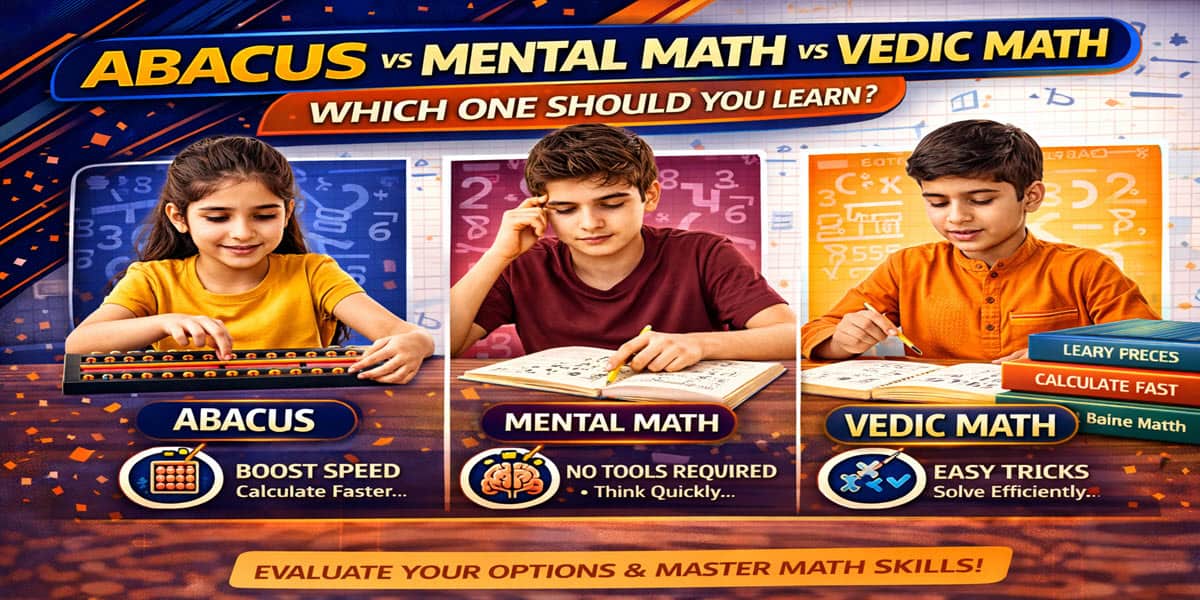
Three systems dominate the world of fast calculation — Abacus, Mental Math, and Vedic Math. All three produce impressive results. All three have passionate advocates. And all three are frequently marketed as "the best" way to learn speed arithmetic.
The reality is more nuanced. Each system has genuine strengths, real limitations, and a specific learner profile it suits best. Choosing the wrong system — or investing years in a system that does not align with your goals — is a costly mistake that thousands of students and parents make every year.
This guide gives you an honest, comprehensive comparison of all three systems across eight critical dimensions — so you can make a fully informed decision based on your age, goals, available time, and budget.
System Overview — What Each One Actually Is The Abacus System
The abacus is one of humanity's oldest calculation tools — a frame with beads that represent numerical values by position. Abacus-based learning teaches children to mentally visualize a virtual abacus and manipulate its beads to perform arithmetic.
The system is primarily taught in structured classroom programs — most famously by organizations like UCMAS (Universal Concept of Mental Arithmetic System) and SIP Abacus. Training typically spans 2–3 years with weekly classes and daily practice.
The core claim of abacus training is not just faster arithmetic — it is broader cognitive development including improved concentration, photographic memory, and enhanced whole-brain engagement through simultaneous use of left and right brain hemispheres.
Mental Math
Mental math is not a single unified system — it is a collection of arithmetic techniques drawn from various sources including number theory, pattern recognition, and cognitive psychology. It includes tricks like the 10% breakdown for percentages, left-to-right addition, cross multiplication, and number decomposition.
Mental math techniques are taught in books, online platforms, and through direct practice. There is no single governing syllabus — the content varies significantly by source. SpeedMath.in's practice modules are built around mental math techniques tailored specifically for competitive exam arithmetic.
The core claim of mental math training is direct: faster, more accurate arithmetic through systematic application of proven calculation shortcuts.
Vedic Math
Vedic Mathematics is a structured system of 16 sutras (formulas) and 13 sub-sutras derived from ancient Indian mathematics and compiled by Bharati Krishna Tirthaji in the early 20th century. Each sutra encodes a calculation principle applicable across multiple arithmetic and algebraic operations.
Vedic Math is taught through books, coaching institutes, and online courses. It has a defined syllabus and a clear progression from basic to advanced sutras.
The core claim of Vedic Math is mathematical elegance and efficiency — that its sutras reduce complex calculations to single-line mental operations that are both faster and more insightful than conventional methods.
Head-to-Head Comparison Across 8 Dimensions
Dimension 1: Ideal Learning Age
| System | Ideal Age | Can Adults Learn? |
|---|---|---|
| Abacus | 5–12 years | Possible but significantly harder — the visualization method relies on neural plasticity that peaks in childhood |
| Mental Math | Any age | Yes — equally effective for children and adults |
| Vedic Math | 10+ years | Yes — algebraic understanding required for advanced sutras |
Verdict: Abacus is primarily a childhood system. Mental math and Vedic Math work across all ages.
Dimension 2: Time to Measurable Results
| System | Basic results | Full proficiency |
|---|---|---|
| Abacus | 6–12 months | 2–3 years of structured training |
| Mental Math | 2–4 weeks | 3–6 months of daily practice |
| Vedic Math | 1–2 weeks per sutra | 4–8 months for full system |
Verdict: Mental math produces the fastest visible results. Vedic Math is close behind. Abacus requires the longest time investment before practical application.
Dimension 3: Competitive Exam Relevance
This is perhaps the most important dimension for students preparing for SSC, RRB, IBPS, CAT, or similar examinations.
| System | Exam Relevance | Reason |
|---|---|---|
| Abacus | Low–Medium | Visualization-based — hard to apply under timed exam pressure for learners who did not train from childhood |
| Mental Math | Very High | Techniques directly target the arithmetic types tested in competitive exams |
| Vedic Math | High | Sutras like Nikhilam, Urdhva Tiryagbhyam, and Ekanyunena directly accelerate exam-relevant calculations |
Verdict: Mental math and Vedic Math are significantly more useful for competitive exam preparation than abacus training started in adulthood.
Dimension 4: Cognitive Benefits Beyond Arithmetic
| System | Documented Cognitive Benefits |
|---|---|
| Abacus | Strongest evidence — improved working memory, concentration, spatial reasoning, and whole-brain development in children |
| Mental Math | Moderate — improved numerical reasoning, pattern recognition, working memory under mathematical load |
| Vedic Math | Moderate — improved algebraic intuition, pattern recognition, mathematical confidence |
Verdict: Abacus has the strongest documented cognitive benefits — but primarily for children who begin training early. For adults, the cognitive benefits of all three systems are broadly comparable.
Dimension 5: Cost and Accessibility
| System | Typical Cost | Accessibility |
|---|---|---|
| Abacus | ₹3,000–₹8,000 per year (classroom program) | Requires in-person classes or structured program |
| Mental Math | Free–₹500 (books/apps/platforms) | Fully self-teachable from books, platforms, YouTube |
| Vedic Math | ₹500–₹2,000 (books/courses) | Largely self-teachable with good books |
Verdict: Mental math is the most accessible and cost-effective system. Both Vedic Math and mental math can be learned entirely independently at minimal cost.
Dimension 6: Difficulty of Learning
| System | Learning Difficulty | Primary Challenge |
|---|---|---|
| Abacus | Medium for children, High for adults | Mental bead visualization requires significant training |
| Mental Math | Low–Medium | Learning which technique to apply when |
| Vedic Math | Medium | Remembering sutra conditions and applications |
Verdict: Mental math has the lowest barrier to entry. Basic techniques produce results within days for most learners.
Dimension 7: Applicability Beyond Basic Arithmetic
| System | Handles Advanced Math? |
|---|---|
| Abacus | Limited — primarily addition, subtraction, multiplication, division |
| Mental Math | Moderate — covers arithmetic through basic algebra and statistics |
| Vedic Math | High — covers arithmetic, algebra, geometry, calculus foundations |
Verdict: Vedic Math has the broadest mathematical coverage. Abacus is the most limited in scope.
Dimension 8: Sustainability as a Long-Term Skill
| System | Long-Term Retention | Maintenance Required |
|---|---|---|
| Abacus | High if trained in childhood — fades without practice in adulthood | Regular practice needed to maintain visualization speed |
| Mental Math | High — techniques are logical shortcuts that stay intuitive once learned | Minimal — occasional practice refreshes all techniques |
| Vedic Math | High — mathematical identities do not change | Minimal — understanding the why ensures long-term retention |
Verdict: All three systems require some maintenance practice. Mental math and Vedic Math require less ongoing effort to retain because they are logic-based rather than visualization-based.
Summary Comparison Table
| Dimension | Abacus | Mental Math | Vedic Math |
|---|---|---|---|
| Best age | 5–12 | Any | 10+ |
| Time to results | Months | Weeks | Weeks |
| Exam relevance | Low–Medium | Very High | High |
| Cognitive benefits | Highest (children) | Moderate | Moderate |
| Cost | High | Low | Low |
| Difficulty | High (adults) | Low | Medium |
| Advanced math | Limited | Moderate | High |
| Self-teachable | No | Yes | Yes |
Clear Recommendations by Learner Type
If you are a parent of a child aged 5–10:
Choose Abacus — the cognitive development benefits during this critical neural plasticity window are unmatched. The visualization skills developed through abacus training form a foundation that supports all future mathematical learning. Enroll in a structured program (UCMAS, SIP Abacus, or equivalent) rather than attempting self-teaching.
If you are a student aged 11–16 preparing for school exams:
Choose Vedic Math + Mental Math — Vedic Math provides elegant shortcuts for the algebra and arithmetic in school syllabuses, while mental math techniques handle the calculation speed needed for timed assessments. Begin with the five most exam-relevant sutras (Ekadhikena, Nikhilam, Urdhva Tiryagbhyam, Ekanyunena, Yavadunam) before branching out.
If you are an adult preparing for competitive exams (SSC, RRB, IBPS):
Choose Mental Math as primary, Vedic Math as supplement — mental math techniques are directly mapped to competitive exam arithmetic and produce measurable speed improvements within 2–4 weeks. Add Vedic Math sutras for multiplication and squaring operations once the core mental math toolkit is established. Practice daily on SpeedMath.in to build exam-specific calculation fluency.
If you are an adult learner with no specific exam goal:
Choose Mental Math — it is the lowest-effort entry point, immediately applicable to daily life (shopping, billing, estimation), and produces quick visible results that sustain motivation for continued practice.
If you already have strong arithmetic and want to go deeper:
Choose Vedic Math — its coverage of algebra, geometry, and calculus foundations makes it the most intellectually rewarding of the three systems for learners who have already mastered basic arithmetic shortcuts.
Can You Combine All Three?
Yes — and the most capable mental calculators typically do. The optimal combination depends on your timeline:
Short timeline (exam in 2–3 months):
Focus exclusively on mental math. Do not attempt to learn Vedic sutras simultaneously — depth beats breadth under time pressure.
Medium timeline (exam in 6–12 months):
Build mental math foundation first (weeks 1–6), then add the five most relevant Vedic sutras (weeks 7–16), then integrate both through mixed timed practice (weeks 17 onwards).
Long timeline (no specific exam, general improvement):
Learn Vedic Math systematically through a structured book or course. Use mental math techniques for daily arithmetic practice. If you have children, enroll them in abacus training simultaneously — the systems complement rather than conflict.
A Note on Platforms and Resources
For Abacus: In-person structured programs are strongly recommended over self-teaching. UCMAS, SIP Abacus, and Mastermind Abacus are the most established programs in India.
For Mental Math: SpeedMath.in provides timed practice modules specifically designed for the mental math techniques most relevant to Indian competitive exams. The platform's topic isolation and progressive difficulty features align perfectly with the accuracy-first learning method.
For Vedic Math: Vedic Mathematics by Bharati Krishna Tirthaji is the original source. The Trachtenberg Speed System provides a complementary Western perspective. Online courses by organizations like the Vedic Mathematics Academy provide structured progression.