
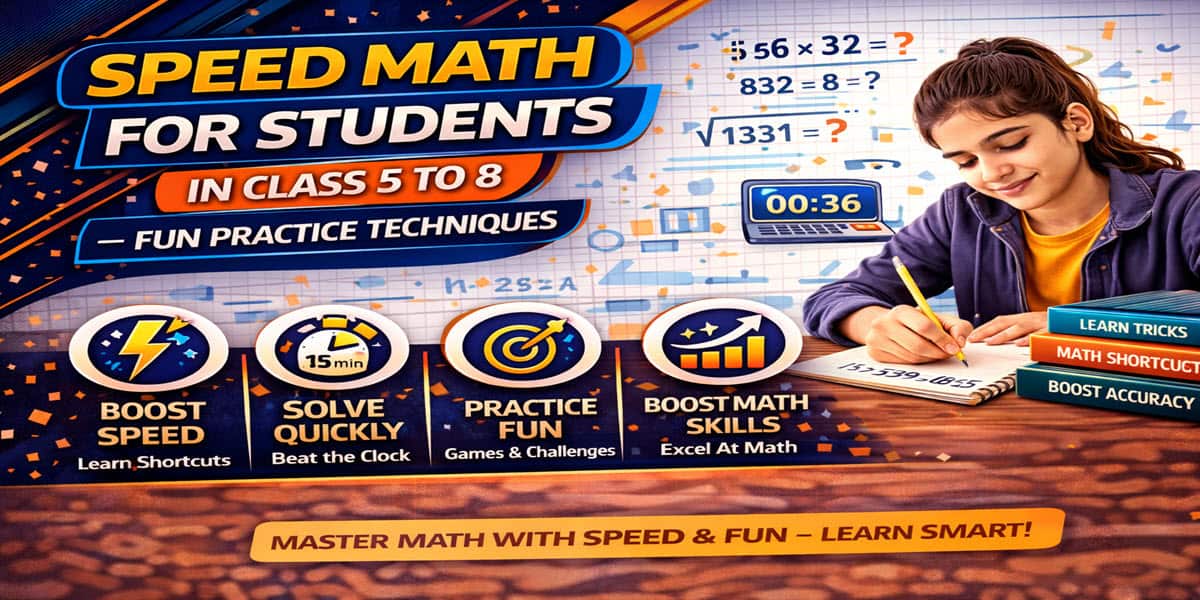
Class 5 to Class 8 is the single most important window for building mathematical speed and confidence. The concepts are accessible — multiplication, fractions, percentages, basic algebra — yet the habits and reflexes formed during these years shape every mathematical experience that follows: board exams, competitive exams, college entrance tests, and beyond.
Students who develop strong calculation speed during this window carry a compound advantage for the rest of their academic lives. Students who do not often develop math anxiety that grows harder to address with every passing year.
The challenge is that conventional school math — focused on procedural correctness and exam marks — rarely teaches calculation speed explicitly. Students learn how to get the right answer eventually. They are rarely taught how to get it fast.
This guide fills that gap. It covers age-appropriate speed math techniques specifically calibrated for Class 5 to 8 students, presented in a way that makes fast math feel exciting rather than burdensome — because at this age, the learning method matters as much as the content.
Why Class 5 to 8 Is the Critical Window
Neural Plasticity Peak
Between ages 10 and 14, the brain undergoes a second major wave of neural development — synaptic pruning and myelination — that dramatically increases the efficiency of pathways used repeatedly during this period. Mathematical skills practiced intensively during this window become deeply wired in a way that is harder to achieve after age 16.
In practical terms: a multiplication shortcut learned and practiced at age 11 becomes an automatic reflex. The same shortcut learned at age 17 requires conscious application for years before achieving similar automaticity.
Foundation for All Future Math
Every major math topic from Class 9 onwards — quadratic equations, trigonometry, coordinate geometry, statistics — requires fast arithmetic as a prerequisite. Students who reach Class 9 with slow basic arithmetic spend cognitive resources on calculation that should be available for conceptual problem-solving.
Confidence Formation Window
Mathematical self-concept — whether a student sees themselves as "good at math" or "bad at math" — crystallizes largely during the middle school years. Students who experience visible speed improvements during Class 5–8 develop a positive mathematical identity that sustains engagement through harder topics.
Age-Appropriate Techniques by Class Level
Class 5 — Building Number Sense (Ages 10–11)
At this level, the focus is on making arithmetic feel intuitive rather than mechanical. Three techniques are ideal:
Technique 1: The Friendly Numbers Method
Round numbers to the nearest friendly (easy) number, calculate, then adjust.
- 38 + 47 → 40 + 47 − 2 = 85
- 63 − 28 → 63 − 30 + 2 = 35
- 97 + 56 → 100 + 56 − 3 = 153
Why it works for this age: Children at Class 5 level are comfortable with multiples of 10 — this technique builds on existing comfort rather than introducing entirely new concepts.
Technique 2: Multiplication by 11 (The Magic Trick)
Present this as a "trick" — children at this age respond powerfully to the feeling of knowing a secret method adults do not.
- 23 × 11 → 2_3 → put 2+3=5 in the middle → 253
- 45 × 11 → 4+5=9 → 495
- 72 × 11 → 7+2=9 → 792
When the middle sum exceeds 9: 78 × 11 → 7+8=15 → carry 1 → 858
Technique 3: Doubling and Halving
Make multiplication easier by halving one number and doubling the other until the calculation becomes trivial.
- 16 × 25 → 8 × 50 → 4 × 100 = 400
- 14 × 35 → 7 × 70 = 490
- 12 × 45 → 6 × 90 = 540
Class 6 — Multiplication and Fraction Speed (Ages 11–12)
Technique 4: Squaring Numbers Ending in 5
By Class 6, students encounter squares regularly. This trick produces immediate excitement because it works on any number ending in 5.
- 35² → 3×4=12 → append 25 → 1225
- 55² → 5×6=30 → 3025
- 75² → 7×8=56 → 5625
- 95² → 9×10=90 → 9025
Classroom activity: Have students race to find squares of 15, 25, 35, 45, 55, 65, 75, 85, 95 — first correct answer wins. The pattern across results (25, 625, 1225, 2025...) itself becomes a learning moment about number patterns.
Technique 5: Fraction Simplification Using Divisibility Rules
Class 6 introduces fractions heavily. Teach divisibility rules as the primary simplification tool — not long division.
- 24/36 → both even → 12/18 → both divisible by 6 → 2/3
- 45/60 → both divisible by 15 → 3/4
- 56/84 → both divisible by 28 → 2/3
Technique 6: The Percentage Building Blocks
Introduce percentage as a building block system rather than a formula.
- 10% = shift decimal left once
- 5% = half of 10%
- 1% = shift decimal left twice
- Any% = combination of the above
Example: 15% of 80:
- 10% = 8
- 5% = 4
- 15% = 12
Class 7 — Ratio, Proportion and Algebra Foundations (Ages 12–13)
Technique 7: The One-Part Method for Ratios
This technique becomes invaluable in Class 7 and stays relevant through competitive exams.
- If A:B = 3:5 and total = 240 → one part = 240÷8 = 30 → A=90, B=150
- If A:B:C = 2:3:4 and total = 180 → one part = 180÷9 = 20 → A=40, B=60, C=80
Technique 8: Solving Simple Equations Mentally
Teach mental equation solving through the "balance" visualization — what you do to one side, you do to the other.
- 3x + 7 = 22 → 3x = 15 → x = 5 (mental, 3 seconds)
- 5x − 8 = 32 → 5x = 40 → x = 8 (mental, 3 seconds)
- 2x/3 = 14 → x = 14×3/2 = 21 (mental, 4 seconds)
Technique 9: Multiplication Near 100 (Vedic Nikhilam — Simplified)
Introduce this as a "near-100 trick" without the formal Vedic terminology.
- 97 × 96: (97−4)(4×3) = 93 | 12 = 9312
- 98 × 95: (98−5)(5×2) = 93 | 10 = 9310
- 103 × 104: (103+4)(3×4) = 107 | 12 = 11112
Class 8 — Advanced Arithmetic and Pre-Algebra Speed (Ages 13–14)
Technique 10: Percentage Increase/Decrease as Multipliers
Class 8 students encounter percentage change problems. Teach the multiplier concept directly.
- 20% increase → ×1.2
- 15% decrease → ×0.85
- 25% increase → ×1.25 = ×5/4
Example: A price of ₹640 increases by 25%. New price?
- 640 × 5/4 = ₹800 (mental, 4 seconds)
Technique 11: Squares Using (a+b)² and (a−b)²
Class 8 students learn these algebraic identities — connect them immediately to mental calculation.
- 43² = (40+3)² = 1600+240+9 = 1849
- 78² = (80−2)² = 6400−320+4 = 6084
- 97² = (100−3)² = 10000−600+9 = 9409
Technique 12: The Harmonic Mean for Average Speed
Class 8 students begin speed-distance problems. Teach the harmonic mean formula immediately.
- Equal distances at S₁ and S₂: Avg speed = 2S₁S₂/(S₁+S₂)
- 60 km/h going, 40 km/h returning: 2×60×40/(60+40) = 4800/100 = 48 km/h
5 Fun Practice Games for Class 5–8
Games transform practice from obligation to engagement — and engagement is the single most important variable in learning speed at this age.
Game 1: The 60-Second Blitz
Set a timer for 60 seconds. Write 20 multiplication problems on a sheet. Student solves as many as possible before the timer ends. Record score daily and track improvement over weeks.
Why it works: The fixed time creates urgency without punishment. Students naturally compete against their own previous score — a healthier motivation than competing against others.
Game 2: Number Chain
One person says a number. The next person must say a number that is double, triple, or half of the previous one — within 5 seconds. Continue until someone takes more than 5 seconds or gives a wrong answer.
Example chain: 8 → 16 → 4 → 12 → 6 → 18 → 9 → 27...
Why it works: Builds multiplication and division reflexes in a social, game-like format with no writing required.
Game 3: The Estimation Challenge
Show a calculation problem for 3 seconds, then hide it. Students write their best estimate. The student whose estimate is closest to the correct answer wins — not the student who gets it exactly right.
Why it works: Develops number sense and approximation skills — equally important as exact calculation for competitive exams.
Game 4: Flash Card Duel
Two students face each other with a stack of multiplication or percentage flash cards. Cards are shown one at a time — first student to call the correct answer keeps the card. Most cards at the end wins.
Why it works: The competitive element creates maximum engagement. The need to answer quickly builds automaticity.
Game 5: SpeedMath.in Daily Challenge
Use SpeedMath.in's daily challenge module as a consistent daily game — 5 minutes of timed problems with an automatic score. Students can compare their scores across days and across friends using the platform.
Why it works: Digital platforms provide immediate feedback and automatic progress tracking — both critical motivators for this age group.
A Daily 10-Minute Practice Routine for Class 5–8
Unlike adult exam aspirants who need 15–20 minute sessions, Class 5–8 students benefit most from shorter, higher-frequency practice.
| Time | Activity |
|---|---|
| 0–2 min | 10 mental multiplication problems (tables 11–20) |
| 2–5 min | Topic drill: today's focus technique (rotate daily) |
| 5–8 min | SpeedMath.in daily challenge or flash card game |
| 8–10 min | One "challenge problem" slightly above current level |
Weekly topic rotation:
| Day | Focus |
|---|---|
| Monday | Multiplication tricks |
| Tuesday | Squares and cubes |
| Wednesday | Percentage building blocks |
| Thursday | Fraction simplification |
| Friday | Ratio one-part method |
| Saturday | Mixed speed challenge |
| Sunday | Free choice — student picks favorite technique |
How Parents Can Help at Home
Parents do not need to be math experts to support their child's speed math development. These four approaches require no mathematical knowledge:
1. Ask estimation questions daily
"We need to buy 6 items at ₹47 each — roughly how much will it cost?" Encouraging mental estimation in real-world contexts builds number sense without any formal practice structure.
2. Time everything
When your child does math homework, occasionally time how long specific calculations take. "How fast can you find 35% of 280?" The presence of a timer — even casually — builds time awareness.
3. Celebrate process over results
Praise the method ("That was a clever way to break that down") rather than only the answer ("That is correct"). Process praise develops mathematical thinking; answer praise develops answer-seeking.
4. Use SpeedMath.in together
Sitting with your child during their daily SpeedMath.in session for even 5 minutes — not helping, just being present — signals that math practice is valued and important. Parental presence during practice is one of the strongest predictors of consistent habit formation in middle school students.