
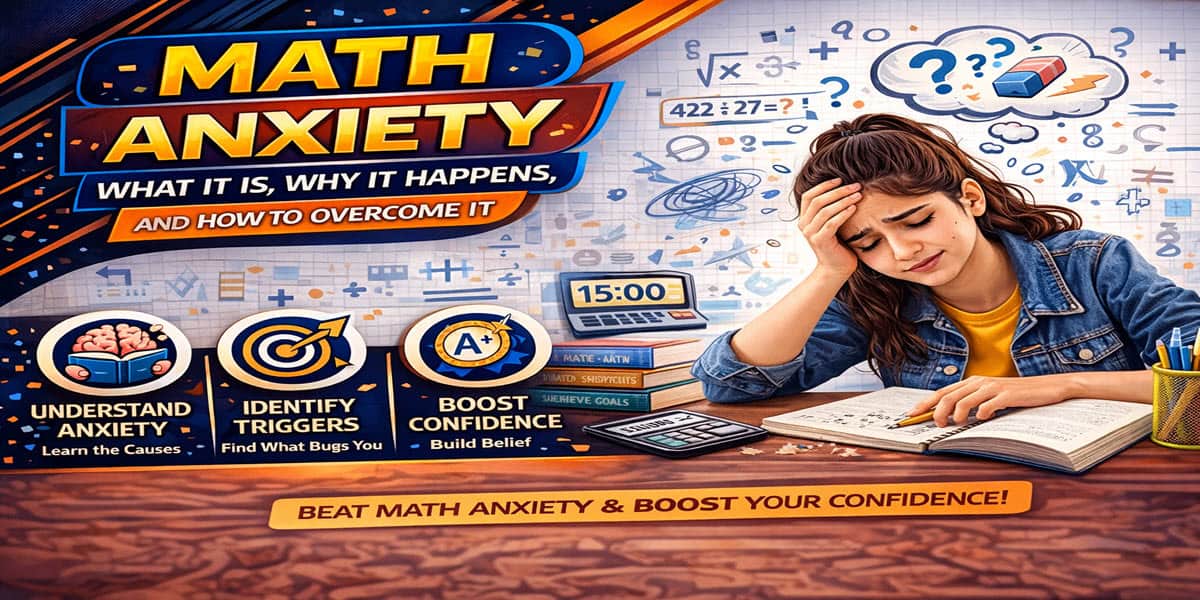
You know the feeling. The exam paper lands on your desk. You read the first math question and your mind goes completely blank. Your heart rate rises, your palms sweat, and a quiet voice in your head says: "I cannot do this."
This is not a lack of intelligence. It is not laziness. It is not even a lack of preparation in many cases. It is math anxiety — a genuine, measurable psychological response that interferes with mathematical thinking and performance.
Math anxiety affects an estimated 17–20% of the population to a significant degree, with millions more experiencing milder forms. It is more common than most people admit, more debilitating than most teachers recognize, and — most importantly — entirely treatable with the right approach.
This guide explains exactly what math anxiety is, what causes it, how it operates in the brain, and eight practical strategies to overcome it — whether you are a student preparing for competitive exams, a parent trying to help a child, or an adult who has carried this fear for years.
What Is Math Anxiety — Precisely Defined
Math anxiety is defined by researchers as "a feeling of tension and anxiety that interferes with the manipulation of numbers and the solving of mathematical problems in a wide variety of ordinary life and academic situations."
It is distinct from simply disliking math or finding it difficult. The key word is interferes — math anxiety actively disrupts cognitive performance even when the person has the knowledge required to solve the problem. A student who knows their multiplication tables perfectly can experience math anxiety that prevents them from recalling those facts under exam pressure.
Math Anxiety vs General Test Anxiety
Math anxiety is specific — it activates in mathematical contexts but not in other subjects. A student can be completely calm during a history exam and experience significant anxiety during a math test. This specificity confirms that math anxiety is not simply generalized exam nervousness — it is a conditioned response to mathematical stimuli.
What Math Anxiety Is NOT
- Not a sign of low intelligence
- Not an indication that someone "cannot do math"
- Not a permanent condition
- Not caused by laziness or lack of effort
- Not something students should be expected to simply "push through"
The Brain Science Behind Math Anxiety
Understanding how math anxiety works in the brain removes much of its power — because you realize it is a mechanical process, not a personal flaw.
The Amygdala Hijack
The amygdala is the brain's threat-detection center. It evolved to respond to physical dangers — predators, falls, attacks. When math anxiety is present, the amygdala treats mathematical situations as genuine threats, triggering the same fight-or-flight response as a physical danger.
This response releases cortisol and adrenaline, which:
- Redirect blood flow away from the prefrontal cortex (the reasoning and calculation center)
- Narrow attention to threat-related information
- Impair working memory — the mental workspace needed for multi-step calculations
In practical terms: math anxiety literally reduces your brain's available computing power at the exact moment you need it most.
Working Memory Disruption
Sian Beilock, a neuroscientist at the University of Chicago, has extensively studied math anxiety's effect on working memory. Her research shows that high math anxiety consumes working memory resources through intrusive worried thoughts ("I am going to fail," "I am too slow," "everyone else is done already") — leaving less capacity for actual mathematical processing.
This explains why a student who can solve a problem calmly at home fails to solve the same problem under exam conditions. Their math knowledge has not changed — their available working memory has been hijacked by anxiety.
Root Causes of Math Anxiety
Math anxiety rarely appears from nowhere. It typically develops from one or more of these identifiable sources.
1. Early Negative Experiences
A single humiliating experience — being called on in class and not knowing the answer, being laughed at for a wrong calculation, receiving a poor grade with harsh feedback — can establish a negative association with math that persists for years.
2. Teacher or Parent Attitudes
Research consistently shows that math anxiety is partially transmitted from adults to children. Teachers who express their own discomfort with math, or parents who say "I was never good at math either," inadvertently signal to children that mathematical difficulty is expected and acceptable.
3. Timed Tests Without Preparation
Introducing time pressure before a student has developed adequate calculation fluency creates a high-anxiety situation with no available coping mechanism. The student learns to associate math with stress — not from the math itself, but from the time pressure.
4. Fixed Mindset Beliefs
Students who believe mathematical ability is fixed ("you either have a math brain or you do not") interpret every difficulty as confirmation of permanent inadequacy. This belief system — described extensively by Carol Dweck's research on mindset — is a major amplifier of math anxiety.
5. Repeated Failure Without Diagnosis
When a student struggles consistently without anyone identifying the specific gap in their knowledge, they accumulate gaps on top of gaps. Eventually the problems seem unsolvable — but the root cause is a single missing foundational concept, not a global inability.
8 Proven Strategies to Overcome Math Anxiety
Strategy 1: Expressive Writing Before Math Sessions
This is one of the most evidence-backed interventions for math anxiety. Research by Ramirez and Beilock (2011) published in Science showed that students who wrote freely about their math worries for 10 minutes before an exam scored significantly higher than those who did not.
How to do it:
Before any math practice session or exam, spend 5–10 minutes writing down everything you are worried about regarding the upcoming math. Do not filter or organize — just write freely.
Why it works: Expressive writing externalizes anxious thoughts, removing them from working memory and reducing their interference with mathematical processing.
Strategy 2: Controlled Breathing
Slow, controlled breathing directly counteracts the physiological fight-or-flight response by activating the parasympathetic nervous system.
The 4-7-8 technique:
- Inhale for 4 counts
- Hold for 7 counts
- Exhale slowly for 8 counts
- Repeat 3–4 times
Practice this before starting any math session. After two weeks of consistent use, the breathing pattern becomes an automatic anxiety-reduction trigger.
Strategy 3: Reframe the Physical Response
Research by Alison Wood Brooks at Harvard Business School showed that reinterpreting anxiety arousal as excitement — rather than trying to calm down — significantly improves performance on challenging cognitive tasks.
Practical application:
When you feel math anxiety symptoms (racing heart, shallow breathing, mental tension), say to yourself: "I am excited" rather than "I am anxious." The physiological symptoms are identical — what changes is the cognitive interpretation and its effect on performance.
Strategy 4: Identify and Fill Specific Knowledge Gaps
Math anxiety compounds when students face problems built on concepts they never properly learned. A student anxious about algebra may actually have a gap in fraction understanding from two years earlier.
How to find your gaps:
- Work backward from where confusion begins
- Identify the earliest point where problems feel genuinely unclear
- Fill that specific gap before continuing forward
This strategy transforms an overwhelming general anxiety ("I am bad at math") into a manageable specific problem ("I need to review fraction division"). Specific problems have specific solutions — and that realization alone reduces anxiety.
Strategy 5: Separate Timed and Untimed Practice
Introducing time pressure too early is one of the primary causes of math anxiety. Build a two-phase practice routine:
Phase 1 — Untimed: Practice new concepts without any time pressure until accuracy reaches 85–90%. The goal here is understanding, not speed.
Phase 2 — Timed: Gradually introduce time pressure only after accuracy is established. Start with generous time limits (3× your comfortable pace) and reduce slowly over weeks.
This sequence teaches the brain that mathematical situations are solvable — building confidence before adding the stress of time pressure.
Strategy 6: Use Growth Mindset Language
The words you use when talking about math — to yourself and others — directly shape your mathematical self-concept.
Replace fixed mindset language with growth mindset language:
| Fixed Mindset | Growth Mindset |
|---|---|
| "I am not a math person" | "I have not mastered this yet" |
| "I cannot do this" | "I cannot do this yet" |
| "I am too slow" | "My speed is improving" |
| "Math is impossible for me" | "This topic needs more practice" |
| "I always make mistakes" | "Mistakes show me what to practice next" |
The word "yet" is particularly powerful — it converts a permanent statement of failure into a temporary statement of current position.
Strategy 7: Gradual Exposure — Build From Certainty
Avoidance is the primary maintenance mechanism of any anxiety. The more a student avoids math, the more the anxiety grows. Gradual exposure — systematically approaching feared situations in small steps — is the gold standard treatment for anxiety of any kind.
A gradual exposure ladder for math anxiety:
| Step | Activity | Anxiety Level |
|---|---|---|
| 1 | Read about math topics — no solving | Very low |
| 2 | Watch solved examples on video | Low |
| 3 | Copy worked solutions by hand | Low-medium |
| 4 | Solve problems with solution book open | Medium |
| 5 | Solve problems independently, check after | Medium |
| 6 | Solve problems under self-imposed time limit | Medium-high |
| 7 | Solve problems under exam-like conditions | High — but manageable |
Move up the ladder only when the current step produces minimal anxiety. Rushing the ladder recreates the very experiences that caused the anxiety in the first place.
Strategy 8: Celebrate Process, Not Just Results
Students with math anxiety focus almost entirely on outcomes — right or wrong, pass or fail, fast or slow. This binary evaluation system makes every session a potential confirmation of their worst fears.
Shift the celebration metric:
- Did you attempt problems you would have skipped before? ✓ Worth celebrating
- Did you review a wrong answer instead of ignoring it? ✓ Worth celebrating
- Did you complete 15 minutes of practice when you felt anxious? ✓ Worth celebrating
Process-focused celebration builds the intrinsic motivation that sustains practice — while outcome-focused evaluation undermines it.
A 4-Week Math Anxiety Recovery Plan
| Week | Focus | Daily Practice |
|---|---|---|
| Week 1 | Expressive writing + breathing + untimed easy problems | 10 min writing + 10 min math |
| Week 2 | Growth mindset language + gap identification + untimed medium problems | 5 min writing + 15 min math |
| Week 3 | Gradual timed introduction + accuracy tracking | 15 min timed math + error review |
| Week 4 | Exam simulation + reframing anxiety as excitement | 20 min mock conditions |
For Parents and Teachers — How to Help
If you are supporting a student with math anxiety, these principles matter most:
- Never express your own math anxiety in front of children — it is directly transmitted
- Praise effort and strategy, not speed or correct answers
- Avoid timed drills as punishment or as the primary assessment method
- Make math low-stakes and exploratory before making it high-stakes and evaluated
- Identify specific gaps early — struggling students almost always have a specific missing foundation, not a general inability
- Use SpeedMath.in's no-pressure practice modes to build familiarity before introducing competition or time limits