
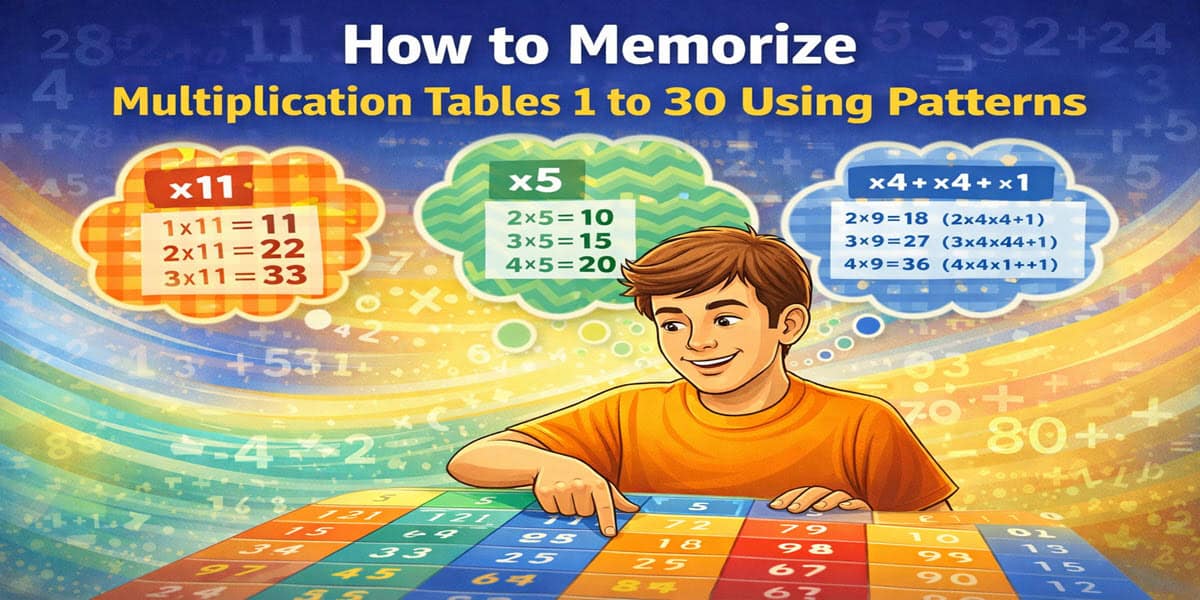
Most students memorize multiplication tables up to 10 through sheer repetition. Then they hit table 11, 12, or beyond — and suddenly the rote memorization approach stops working. The numbers feel arbitrary, the patterns disappear, and the frustration begins.
Here is the truth: multiplication tables are not arbitrary. Every table from 1 to 30 contains hidden patterns, symmetries, and shortcuts that make memorization significantly faster and far more durable than cramming. Once you see these patterns, you do not just memorize the table — you understand it. And understanding is always stronger than memorization.
This guide breaks down every table from 1 to 30 into learnable pattern groups so you can master all of them in a fraction of the time traditional methods require.
Why Pattern-Based Learning Outperforms Rote Memorization
Rote memorization stores information as isolated facts. Pattern-based learning stores information as a connected system. When you forget an isolated fact, it is gone. When you forget one part of a system, you can reconstruct it from the surrounding structure.
Research in cognitive science consistently shows that information learned through patterns and relationships is:
- Retained longer (months vs. days for rote-learned facts)
- Recalled faster under pressure (such as in timed exams)
- More transferable to new problems
For multiplication tables specifically, pattern learning means you never need to memorize 7 × 23 as a standalone fact — instead, you derive it in one second using a technique you already know.
The Foundation: What You Already Know
Before tackling tables 11 to 30, it is worth recognizing how much ground is already covered by what you know.
The multiplication grid from 1 to 30 contains 900 individual facts (30 × 30). However:
- Commutativity cuts this in half: 7 × 13 = 13 × 7, so you only need to learn one direction
- Tables 1 to 10 are already known by most students — this eliminates a large portion
- Patterns and rules covered in this guide eliminate the need to memorize most of the remaining facts
In practice, mastering the techniques in this guide reduces the genuine memorization burden to fewer than 50 anchor facts — everything else is derived.
Group 1: Tables 11 to 19 — The Teen Table System
Tables 11 through 19 follow a elegant pattern that makes them easy to compute on the fly.
The Rule for multiplying any number by a teen (13 to 19):
- Take the non-teen number
- Add the units digit of the teen number to it
- Multiply by 10
- Add the product of the units digits
Example: 7 × 14
- 7 + 4 = 11
- 11 × 10 = 110
- 7 × 4 = 28
- 110 + 28 = 98 ✓
Example: 8 × 17
- 8 + 7 = 15
- 15 × 10 = 150
- 8 × 7 = 56
- 150 + 56 = 206 ✓
Example: 12 × 16
- 12 + 6 = 18
- 18 × 10 = 180
- 12 × 6 = 72
- 180 + 72 = 252 ✓
Once this pattern is internalized, every multiplication involving any teen number becomes a two-step mental calculation.
Special Case: Table of 11
As covered in the previous article, multiplying by 11 is uniquely simple:
- Two-digit number AB × 11 = A(A+B)B
- 36 × 11 = 396, 72 × 11 = 792, 84 × 11 = 924
Special Case: Table of 12
Table of 12 = Table of 10 + Table of 2
- 12 × 7 = 70 + 14 = 84
- 12 × 13 = 130 + 26 = 156
- 12 × 24 = 240 + 48 = 288
Group 2: Tables 20 to 29 — The Decomposition Method
Any number multiplied by 20–29 can be broken into two clean multiplications.
The Rule:
Multiply separately by the tens digit × 10 and the units digit, then add.
Table of 21:
- 21 × N = 20N + N = (2N × 10) + N
- 21 × 7 = 140 + 7 = 147
- 21 × 13 = 260 + 13 = 273
- 21 × 25 = 500 + 25 = 525
Table of 24:
- 24 × N = 20N + 4N
- 24 × 8 = 160 + 32 = 192
- 24 × 15 = 300 + 60 = 360
Table of 25:
This table has a dedicated shortcut — multiplying by 25 is the same as multiplying by 100 and dividing by 4.
- 25 × 8 = 800 ÷ 4 = 200
- 25 × 13 = 1300 ÷ 4 = 325
- 25 × 36 = 3600 ÷ 4 = 900
- 25 × 44 = 4400 ÷ 4 = 1100
Table of 29:
Use the "near 30" trick — multiply by 30 and subtract the number once.
- 29 × 7 = 210 − 7 = 203
- 29 × 14 = 420 − 14 = 406
- 29 × 25 = 750 − 25 = 725
Group 3: Table of 30
The table of 30 is simply the table of 3 with a zero appended.
- 30 × 7 = 3 × 7 × 10 = 210
- 30 × 14 = 3 × 14 × 10 = 420
- 30 × 23 = 3 × 23 × 10 = 690
If you know your 3 times table, you already know the 30 times table.
The Key Pattern Principles That Cover All Tables
Rather than memorizing table by table, these five universal patterns cover the vast majority of cases across all tables from 1 to 30.
Pattern 1: Near-Round-Number Adjustment
For any number close to a round number (ending in 0), multiply by the round number and adjust.
- × 19 = × 20 − once
- × 29 = × 30 − once
- × 21 = × 20 + once
- × 31 = × 30 + once
Pattern 2: Doubling and Halving
If one number is even, halve it and double the other — repeat until the calculation becomes trivial.
- 28 × 15 → 14 × 30 → 7 × 60 = 420
- 24 × 25 → 12 × 50 → 6 × 100 = 600
- 16 × 25 → 8 × 50 → 4 × 100 = 400
Pattern 3: Distributive Decomposition
Break the larger number into (a + b) and distribute.
- 17 × 23 = 17 × 20 + 17 × 3 = 340 + 51 = 391
- 26 × 14 = 26 × 10 + 26 × 4 = 260 + 104 = 364
Pattern 4: The Symmetry Property
Always verify: is the reverse direction easier?
- 28 × 5 is harder than 5 × 28 → use Trick 3: 28 × 5 = 28 ÷ 2 × 10 = 140
- 13 × 24 = 24 × 13 → 24 × 10 + 24 × 3 = 240 + 72 = 312
Pattern 5: Anchor Memorization for Primes
For prime-number tables (13, 17, 19, 23, 29), there are no factor shortcuts. Memorize the first 10 multiples of each as anchor points, then use addition for the rest.
Table of 13 — First 10 Multiples (Worth Memorizing):
| 13×1 | 13×2 | 13×3 | 13×4 | 13×5 | 13×6 | 13×7 | 13×8 | 13×9 | 13×10 |
|---|---|---|---|---|---|---|---|---|---|
| 13 | 26 | 39 | 52 | 65 | 78 | 91 | 104 | 117 | 130 |
Beyond 10: 13 × 14 = 130 + 13×4 = 130 + 52 = 182
A Practical Memorization Schedule
Do not attempt to learn all tables at once. This 3-week schedule is realistic and sustainable.
Week 1 — Tables 11 to 15
- Day 1–2: Table of 11 (the digit-sum trick)
- Day 3–4: Table of 12 (10 + 2 decomposition)
- Day 5–6: Table of 13 (anchor memorization)
- Day 7: Table of 14 and 15 (teen system + ×5 trick for 15)
Week 2 — Tables 16 to 22
- Day 1–2: Tables 16, 17, 18 (teen system)
- Day 3–4: Table of 19 (×20 − once)
- Day 5–6: Tables 20 and 21 (decomposition)
- Day 7: Table of 22 (double of 11)
Week 3 — Tables 23 to 30
- Day 1–2: Table of 23 (decomposition: ×20 + ×3)
- Day 3: Table of 24 (×20 + ×4)
- Day 4: Table of 25 (÷4 × 100 shortcut)
- Day 5: Tables 26, 27, 28 (decomposition)
- Day 6: Table of 29 (×30 − once)
- Day 7: Table of 30 (table of 3 × 10)
Quick Reference: Best Method per Table
| Table | Best Method | Example |
|---|---|---|
| 11 | Digit-sum insertion | 63×11 = 693 |
| 12 | ×10 + ×2 | 12×14 = 168 |
| 13–19 | Teen system | 8×16 = 128 |
| 19 | ×20 − N | 19×13 = 247 |
| 21 | ×20 + N | 21×12 = 252 |
| 25 | ÷4 × 100 | 25×16 = 400 |
| 29 | ×30 − N | 29×11 = 319 |
| 30 | Table of 3 × 10 | 30×17 = 510 |
How to Test Yourself Effectively
Passive reading of tables does not build speed. Active recall under time pressure does. Use these three self-testing methods:
- Flashcard drilling — write each multiplication on one side, answer on the other. Shuffle and time yourself through a deck of 30 cards daily
- Reverse testing — given the answer (e.g., 364), identify which table combination produced it (26×14 or 14×26)
- Timed online practice — platforms like SpeedMath.in offer randomized multiplication drills across custom table ranges so you can specifically target tables 11–30