
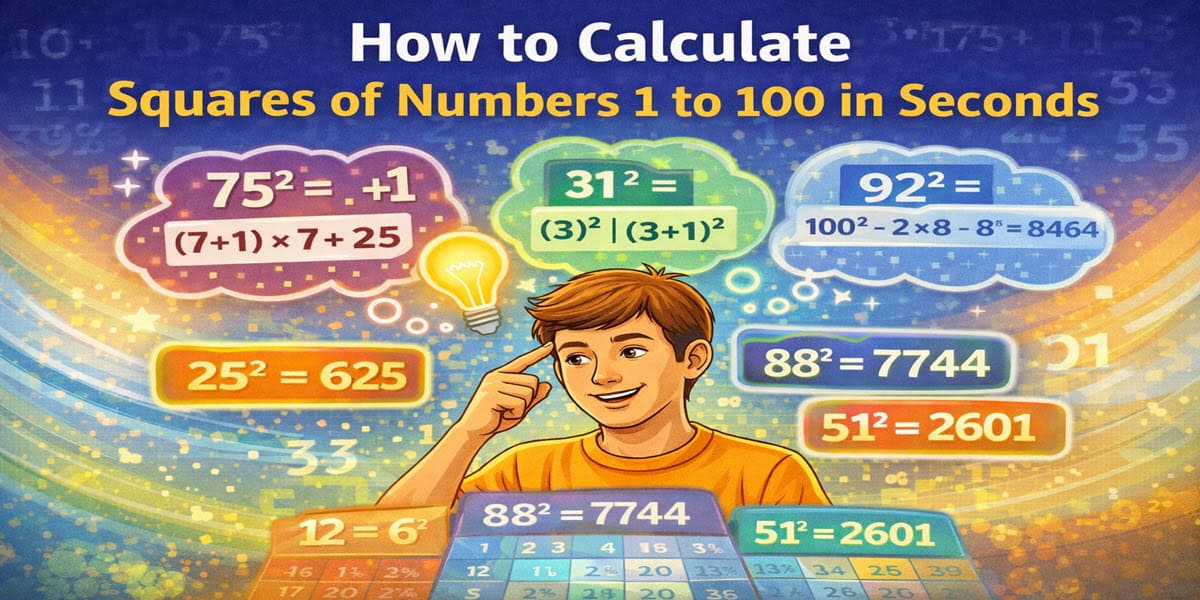
In almost every competitive exam — SSC, IBPS, CAT, RRB, UPSC — squares of numbers appear repeatedly. They show up in simplification problems, geometry questions, algebra, data interpretation, and number series. A candidate who instantly knows that 67² = 4489 or 83² = 6889 has a measurable edge over someone who must work it out from scratch.
The good news is that you do not need to memorize all 100 squares as isolated facts. Instead, a small set of techniques — each built on simple number properties — allows you to derive the square of any number from 1 to 100 in under five seconds. This guide teaches all of them, with fully worked examples for every method.
Part 1: Squares You Should Memorize (1 to 30)
For numbers 1 to 30, direct memorization is the most efficient approach. These 30 values are anchor points — every other technique in this guide builds from them.
Squares of 1 to 30 — Complete Reference Table
| n | n² | n | n² | n | n² |
|---|---|---|---|---|---|
| 1 | 1 | 11 | 121 | 21 | 441 |
| 2 | 4 | 12 | 144 | 22 | 484 |
| 3 | 9 | 13 | 169 | 23 | 529 |
| 4 | 16 | 14 | 196 | 24 | 576 |
| 5 | 25 | 15 | 225 | 25 | 625 |
| 6 | 36 | 16 | 256 | 26 | 676 |
| 7 | 49 | 17 | 289 | 27 | 729 |
| 8 | 64 | 18 | 324 | 28 | 784 |
| 9 | 81 | 19 | 361 | 29 | 841 |
| 10 | 100 | 20 | 400 | 30 | 900 |
Memorization tip: Group them in sets of 5 and notice the gaps between consecutive squares — they always increase by odd numbers (1, 3, 5, 7, 9...). This pattern makes the table self-correcting: if you forget one value, you can derive it from its neighbor.
Part 2: Squares of Numbers Ending in 5 (Any Range)
This is the easiest and most broadly applicable trick — it works for 15, 25, 35, 45 ... all the way to 95 and beyond.
The Rule:
- Take the digit(s) before 5
- Multiply by the next consecutive number
- Append 25
All squares ending in 5 from 15 to 95:
| Number | Calculation | Square |
|---|---|---|
| 15² | 1 × 2 = 2 → 225 | 225 |
| 25² | 2 × 3 = 6 → 625 | 625 |
| 35² | 3 × 4 = 12 → 1225 | 1225 |
| 45² | 4 × 5 = 20 → 2025 | 2025 |
| 55² | 5 × 6 = 30 → 3025 | 3025 |
| 65² | 6 × 7 = 42 → 4225 | 4225 |
| 75² | 7 × 8 = 56 → 5625 | 5625 |
| 85² | 8 × 9 = 72 → 7225 | 7225 |
| 95² | 9 × 10 = 90 → 9025 | 9025 |
Notice the pattern in the results: 25, 625, 1225, 2025, 3025 — the last two digits are always 25, and the leading digits follow a predictable sequence.
Part 3: The (a+b)² and (a−b)² Identity Method
This is the most powerful and universal technique for squaring any number. It uses two algebraic identities:
- (a + b)² = a² + 2ab + b²
- (a − b)² = a² − 2ab + b²
The strategy is to choose a and b such that a is a round number (multiple of 10) and b is small — making all three components easy to compute mentally.
Using (a + b)²
Example 1: 32²
- Write as (30 + 2)²
- = 30² + 2(30)(2) + 2²
- = 900 + 120 + 4
- = 1024
Example 2: 43²
- Write as (40 + 3)²
- = 1600 + 240 + 9
- = 1849
Example 3: 67²
- Write as (60 + 7)²
- = 3600 + 840 + 49
- = 4489
Using (a − b)²
This version is faster when the number is closer to the next round number above it.
Example 1: 38²
- Write as (40 − 2)²
- = 1600 − 160 + 4
- = 1444
Example 2: 49²
- Write as (50 − 1)²
- = 2500 − 100 + 1
- = 2401
Example 3: 78²
- Write as (80 − 2)²
- = 6400 − 320 + 4
- = 6084
Example 4: 97²
- Write as (100 − 3)²
- = 10000 − 600 + 9
- = 9409
Choosing between + and −: If a number ends in 1, 2, 3, 4 — use (a + b)². If it ends in 6, 7, 8, 9 — use (a − b)² with the next round number. Numbers ending in 5 use the dedicated trick from Part 2.
Part 4: The (a+b)(a−b) = a² − b² Method
This identity works in reverse — instead of expanding, you use it to relate the square you want to a square you already know.
The Identity: n² = (n+d)(n−d) + d²
Choose d so that either (n+d) or (n−d) is a round number.
Example 1: 47²
- d = 3 → (47+3)(47−3) + 3² = 50 × 44 + 9
- 50 × 44 = 2200
- 2200 + 9 = 2209
Example 2: 63²
- d = 3 → 66 × 60 + 9 = 3960 + 9 = 3969
Example 3: 72²
- d = 2 → 74 × 70 + 4 = 5180 + 4 = 5184
Example 4: 84²
- d = 4 → 88 × 80 + 16 = 7040 + 16 = 7056
Example 5: 96²
- d = 4 → 100 × 92 + 16 = 9200 + 16 = 9216
This method is particularly efficient when n is near a multiple of 10, because one of the bracket terms becomes trivially easy to multiply.
Part 5: The Consecutive Squares Shortcut
If you know n², you can instantly find (n+1)² without any multiplication.
The Rule: (n+1)² = n² + 2n + 1 = n² + (n + n + 1)
In plain terms: add the current number twice and add 1.
Examples:
- 20² = 400 → 21² = 400 + 20 + 21 = 441
- 25² = 625 → 26² = 625 + 25 + 26 = 676
- 43² = 1849 → 44² = 1849 + 43 + 44 = 1936
- 57² = 3249 → 58² = 3249 + 57 + 58 = 3364
- 79² = 6241 → 80² = 6241 + 79 + 80 = 6400 ✓
This is extremely useful in exams when two consecutive square values appear in the same problem or when you need to verify a calculated result.
Part 6: Patterns in Squares Worth Knowing
Beyond calculation tricks, certain digit patterns in perfect squares help you verify answers and eliminate wrong options in multiple choice questions.
Last Digit Patterns
The last digit of a perfect square can only be: 0, 1, 4, 5, 6, 9
A perfect square can never end in 2, 3, 7, or 8. This immediately eliminates wrong answer choices in exams.
Last Two Digits Patterns
- Numbers ending in 1 or 9: square ends in 01, 21, 41, 61, 81
- Numbers ending in 2 or 8: square ends in 04, 24, 44, 64, 84
- Numbers ending in 3 or 7: square ends in 09, 29, 49, 69, 89
- Numbers ending in 4 or 6: square ends in 16, 36, 56, 76, 96
- Numbers ending in 5: square always ends in 25
- Numbers ending in 0: square always ends in 00
Digital Root Pattern
The digital root (repeated digit sum) of any perfect square is always 1, 4, 7, or 9. If a number's digital root is 2, 3, 5, 6, or 8, it is not a perfect square.
Example: Is 4327 a perfect square?
- Digital root: 4+3+2+7 = 16 → 1+6 = 7 ✓ (could be)
- Last digit: 7 ✗ — not a valid square ending
- Therefore 4327 is not a perfect square — answered in 2 seconds.
Complete Squares Reference: 31 to 100
For quick exam revision, here are all squares from 31 to 100 — derived using the methods above.
| n | n² | n | n² | n | n² | n | n² |
|---|---|---|---|---|---|---|---|
| 31 | 961 | 46 | 2116 | 61 | 3721 | 76 | 5776 |
| 32 | 1024 | 47 | 2209 | 62 | 3844 | 77 | 5929 |
| 33 | 1089 | 48 | 2304 | 63 | 3969 | 78 | 6084 |
| 34 | 1156 | 49 | 2401 | 64 | 4096 | 79 | 6241 |
| 35 | 1225 | 50 | 2500 | 65 | 4225 | 80 | 6400 |
| 36 | 1296 | 51 | 2601 | 66 | 4356 | 81 | 6561 |
| 37 | 1369 | 52 | 2704 | 67 | 4489 | 82 | 6724 |
| 38 | 1444 | 53 | 2809 | 68 | 4624 | 83 | 6889 |
| 39 | 1521 | 54 | 2916 | 69 | 4761 | 84 | 7056 |
| 40 | 1600 | 55 | 3025 | 70 | 4900 | 85 | 7225 |
| 41 | 1681 | 56 | 3136 | 71 | 5041 | 86 | 7396 |
| 42 | 1764 | 57 | 3249 | 72 | 5184 | 87 | 7569 |
| 43 | 1849 | 58 | 3364 | 73 | 5329 | 88 | 7744 |
| 44 | 1936 | 59 | 3481 | 74 | 5476 | 89 | 7921 |
| 45 | 2025 | 60 | 3600 | 75 | 5625 | 90 | 8100 |
| — | — | — | — | — | — | 91 | 8281 |
| — | — | — | — | — | — | 92 | 8464 |
| — | — | — | — | — | — | 93 | 8649 |
| — | — | — | — | — | — | 94 | 8836 |
| — | — | — | — | — | — | 95 | 9025 |
| — | — | — | — | — | — | 96 | 9216 |
| — | — | — | — | — | — | 97 | 9409 |
| — | — | — | — | — | — | 98 | 9604 |
| — | — | — | — | — | — | 99 | 9801 |
| — | — | — | — | — | — | 100 | 10000 |
Recommended Practice Plan
| Week | Focus | Daily Target |
|---|---|---|
| Week 1 | Memorize squares 1–30 | Recall all 30 in under 60 seconds |
| Week 2 | Master the ×5 ending trick + (a±b)² method | 20 random squares per day |
| Week 3 | Practice (a+b)(a−b) method for 31–70 | 15 problems under timed conditions |
| Week 4 | Mixed practice: all methods, 71–100 | Full 1–100 random drill in under 5 min |
SpeedMath.in's squares module lets you set a custom range (e.g., 51–80 only) and tracks your average time per calculation — use this to identify exactly which numbers still slow you down.